Heads up: we earn a commission if you buy through the links on this page, at no extra cost to you. It never changes the order of the list. Full disclosure · how we pick.
You need four things to pull a decent shot at home: a machine, a burr grinder, fresh beans and a scale. That is the whole list. Everything else you will read about is optional, and this page is about the first item only — the other three live on the starter kit page, which is where most of the surprises are. If somebody in the house drinks filter coffee instead, coffee and espresso combo machines covers the machines that do both.
The most useful thing to understand before you spend anything: a first machine is not judged on how good its best shot can be. It is judged on how much has to go right before it makes a drinkable one. That is why the ranking below is ordered by what each machine asks of you, and why the cheapest machine here is not the worst one on the list — it is simply the one that asks you to bring the most. Whatever you choose, pairing a grinder with your espresso machine covers how much of the budget belongs on each half.
Quick picks — Espresso machines for beginners
#
Pick
Best for
Type
Price
1
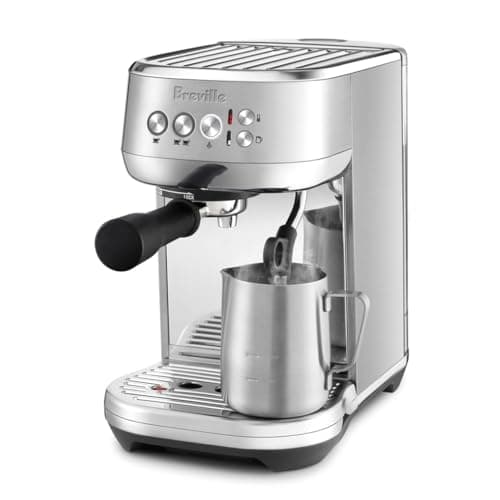
Breville Bambino Plus (BES500)Top pickThe standard answer to “which first machine” — full 54 mm portafilter and an 18 g dose, with the milk step automated so a flat white is possible on day one.
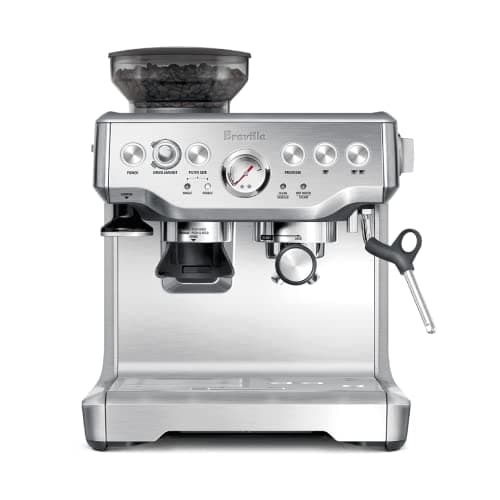
Breville Barista Express (BES870)The default all-in-one: a conical burr grinder with 16 settings built into a machine with a 54 mm basket and PID-controlled temperature.
One box, one counter footprint, machine and grinder together
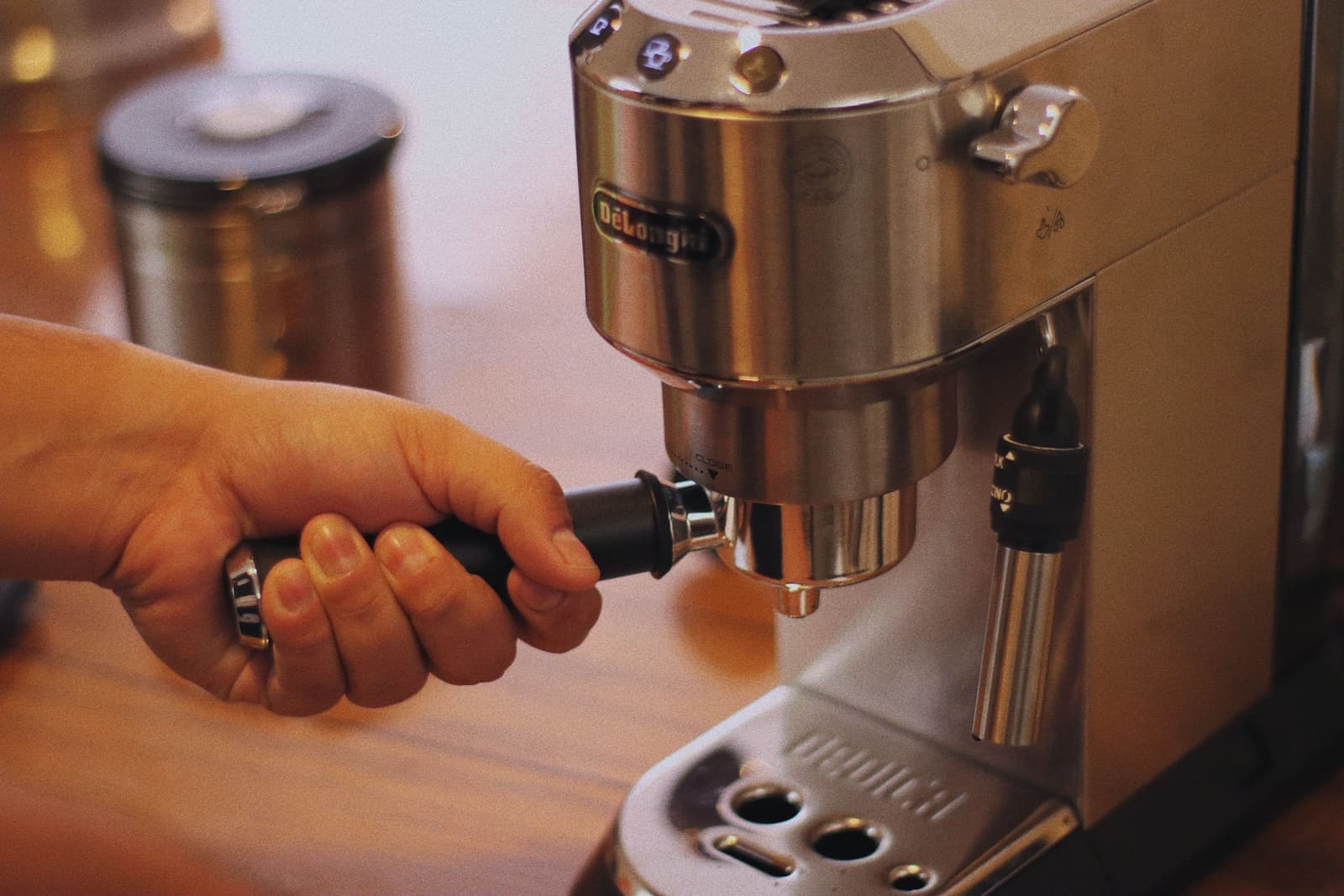
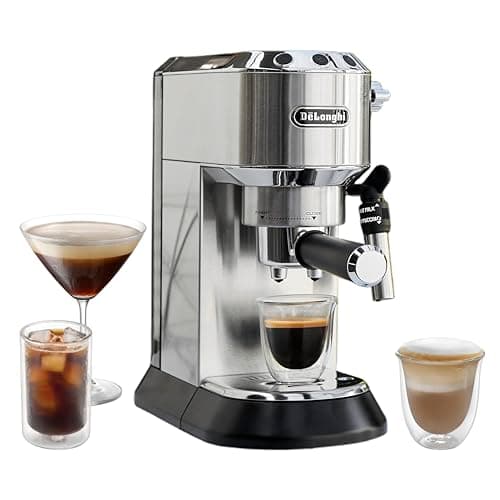
De'Longhi Dedica DeLuxe (EC685)The slim one. De'Longhi states a 15 cm width and calls it the slimmest pump coffee maker they make, which is the whole reason to choose it.
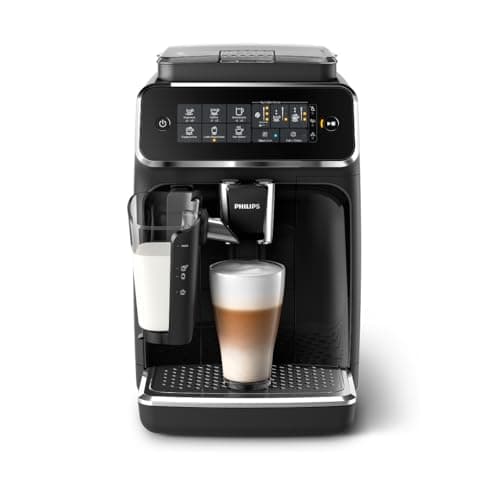
Philips Series 3200 LatteGoA bean-to-cup machine whose milk system is two parts with no tubes, which is the part of an automatic machine people usually come to hate.
Milk drinks with no technique and no cleaning ritual
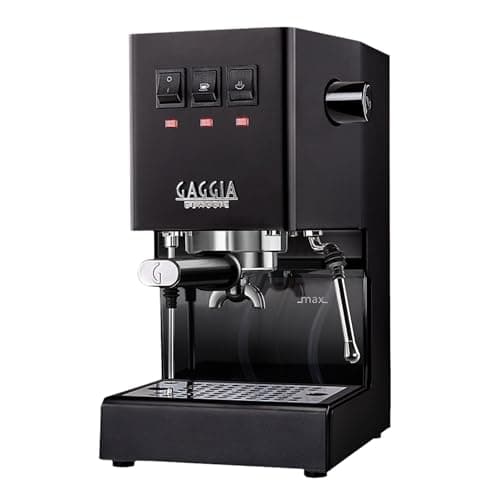
Gaggia Classic Evo ProThe long-running enthusiast entry point: a commercial-size 58 mm portafilter on a home machine, with a large aftermarket behind it.
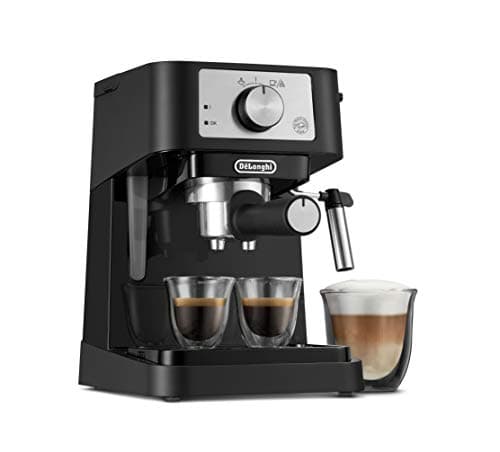
De'Longhi StilosaThe cheapest way to own a pump machine from a brand that will still be there in five years. It is a starting point, not a destination.
We have not handled these units. Everything above comes from published manufacturer documentation, cited inline, plus arithmetic you can redo yourself. Everyone in this category says they tested twenty machines; we have not tested any, and we say so. Here is what we do instead.
01
Breville Bambino Plus (BES500)
A first machine you will not outgrow in a year
The standard answer to “which first machine” — full 54 mm portafilter and an 18 g dose, with the milk step automated so a flat white is possible on day one.
Published specifications for the Breville Bambino Plus (BES500), with sources
54 mm tamper, Razor dosing tool, 16 fl oz milk jug, single- and dual-wall baskets, cleaning tool and disc [source]
The 54 mm portafilter and 18 g dose matter more than they sound: they put the machine on the same dose a cafe uses, so any recipe you read applies to it directly and every 54 mm accessory fits.
The three-second heat-up is the difference between espresso being a weekday habit and a weekend project. A machine that takes fifteen minutes to be ready is a machine you use on Sundays.
The automatic steam wand is the single biggest reason this suits a first setup. Milk texturing is the skill that takes longest to learn; handing it to the machine removes the part most likely to make you give up.
What it does well
Standard 54 mm basket, so recipes and accessories from anywhere fit
Ready in seconds, which is what makes it a habit rather than a project
Automatic milk means a drinkable cappuccino before you can texture by hand
The manual wand is still there when you want to learn
What you give up
No grinder — budget for one separately, and that is the right trade
Small water tank compared with a bean-to-cup machine; refills are frequent
Nothing here helps if your grinder cannot go fine enough
Skip it if you want one box that does everything with no learning curve — a bean-to-cup machine is the honest answer for that, and it is a different product.
Sixteen grind settings is the number to weigh. It is enough to find an espresso grind, and it is not enough to make small corrections once you are close — which is exactly the trade-off you accept for the convenience of one box.
PID temperature control at a stated 200°F is a genuine feature and not a marketing word: it means the water temperature is held rather than allowed to drift between shots.
The footprint argument is the strongest one here. A separate machine and grinder need roughly twice the counter, and on a small kitchen counter that decides it.
What it does well
Machine and grinder in one footprint, which is often the real constraint
Grinds straight into the portafilter — no transfer, no mess step
PID-held brew temperature
Manual wand, so milk skill is learnable on it
What you give up
Sixteen settings is coarse resolution once you are dialing in
The grinder cannot be upgraded independently of the machine
Bigger and heavier than a standalone machine
Skip it if you already own a decent burr grinder — you would be paying twice for the same job, and a separate machine plus your existing grinder will beat it.
Takes ground coffee (1 or 2 cups) and E.S.E. pods [source]
Milk
Adjustable frothing wand / cappuccino system [source]
Fifteen centimeters of width is genuinely unusual and it is why this machine keeps selling. If your counter run is already full, that number decides the purchase before any other spec does.
The E.S.E. pod compatibility is a fair hedge: it means the machine still makes a coffee on the day you have not restocked beans, without committing you to a pod ecosystem.
It uses a smaller basket than the 54 mm standard, so accessories and recipes written for 54 mm machines will not transfer directly.
What it does well
Fits where nothing else fits
Takes ground coffee or E.S.E. pods
Adjustable frothing wand rather than a fixed panarello
What you give up
Non-standard basket size limits accessory choice
Narrow body means a small water tank and frequent refills
Skip it if counter width is not actually your constraint — you are paying for the one thing it is best at and giving up basket standardization to get it.
Aroma Extract system holding water between 90 and 98°C [source]
Milk system
LatteGo, stated to clean under the tap in about 15 seconds [source]
The 20,000-cup burr rating is a durability claim worth reading literally: at three drinks a day that is roughly eighteen years, so the burrs are not the thing that will fail first.
The milk system is the real differentiator. Automatic machines that pump milk through tubes need a cleaning cycle every day; a two-part carafe that rinses under the tap is the version people actually keep up with.
Twelve grind settings is plenty for a machine that also controls dose and yield itself, and would be tight on a machine where you control them.
What it does well
Milk system that is genuinely quick to clean
Ceramic burrs with a published durability figure
No technique required from anyone in the house
What you give up
You do not control dose or yield directly
Larger footprint than a compact espresso machine
Skip it if you want to learn to pull shots. It is built to make that unnecessary, and it succeeds.
The long-running enthusiast entry point: a commercial-size 58 mm portafilter on a home machine, with a large aftermarket behind it.
We have not compiled a cited spec sheet for this pick yet, so there is no spec table here. What follows is about fit — who it is for and who it is not — not about numbers we cannot source. See how we pick.
The 58 mm portafilter is the argument. It is the size commercial machines use, so every basket, tamper, distribution tool and bottomless portafilter on the market fits.
It asks more of you than a Breville does — there is no automatic milk, no PID from the factory, and the learning curve is real.
What it does well
58 mm commercial-standard portafilter with a huge accessory market
Simple, well-understood internals with parts availability
What you give up
Steeper learning curve than a machine designed for beginners
No automatic milk of any kind
Skip it if you want the machine to help you. This one does exactly what you tell it, including when you are wrong.
The cheapest way to own a pump machine from a brand that will still be there in five years. It is a starting point, not a destination.
We have not compiled a cited spec sheet for this pick yet, so there is no spec table here. What follows is about fit — who it is for and who it is not — not about numbers we cannot source. See how we pick.
Machines at this price ship with pressurized baskets, which force crema regardless of grind. That is a feature if you are grinding with something inadequate and a ceiling once you are not.
The honest way to buy at this level is to treat the machine as the cheap half of the setup and put the money into the grinder, because the grinder is what you will keep.
What it does well
The lowest-risk way to find out if you want a machine at all
Forgiving of a mediocre grind while you are still learning
What you give up
A pressurized basket hides what your grind is actually doing
You will feel the ceiling within months if you enjoy it
Skip it if you already know you want this — the money is better spent once, on a machine with a standard basket, than twice.
Four differences do almost all the work. Everything else on a spec sheet is downstream of them.
1. Basket size — and whether it is standard
The portafilter is the handle you lock into the machine, and its basket comes in a few diameters. Most Breville machines use 54 mm; Gaggia and most commercial machines use 58 mm; cheaper machines often use 51 mm or a size of their own. This matters because every accessory you will ever buy — tamper, distribution tool, bottomless portafilter — has to match. Breville states 54 mm and an 18 g dose for the Bambino Plus, the Bambino and the Barista Express, which means one tamper covers all three and every recipe written for an 18 g dose applies directly.
It also decides how much coffee you can fit. An 18 g dose is what a cafe uses; a machine built around a smaller basket is working with less coffee and a different recipe. Neither is wrong — but only one of them lets you follow instructions written by other people. See portafilter sizes explained before you buy any accessory.
2. Pressurized basket, or not
Cheap machines ship with a pressurized (dual-wall) basket. It has a small hole that forces the coffee through under pressure regardless of how coarse your grind is, which manufactures crema and makes almost any coffee produce something that looks right. That is genuinely useful when your grinder is inadequate, and it is a ceiling the moment your grinder is not — because the basket, not your technique, is now deciding the shot.
A non-pressurized (single-wall) basket does nothing for you. It rewards a good grind and punishes a bad one, honestly and immediately. Breville ships both types in the box with the Bambino Plus, which is the right answer: start pressurized, switch when your grinder can carry it.
3. How long it takes to be ready
This decides whether you use the machine on weekdays. Breville states the ThermoJet system in the Bambino Plus reaches extraction temperature in three seconds. A machine with a traditional boiler is genuinely warm in ten to twenty minutes. Both make good coffee; only one of them makes it on a Tuesday at 7am. Thermoblock vs boiler compares the two heating systems in full.
4. Who steams the milk
Milk texturing is the skill that takes longest to learn and the one most likely to make someone give up. An automatic wand does it for you. A manual wand does not. Breville positions the Bambino Plus over the plain Bambino on exactly this difference and nothing else — so if you drink lattes and have never steamed milk, that one feature is what you are paying the difference for. If you drink espresso black, it is a feature you would never use.
The four decisions, and who each one favors
Decision
The easy option
The option with more headroom
Basket size
Whatever the machine ships with
54 mm or 58 mm — standard, so accessories fit
Basket type
Pressurized, forgiving of a rough grind
Single-wall, honest about your grind
Heat-up
Seconds — a weekday machine
Boiler warm-up, more stable once hot
Milk
Automatic wand, drinkable on day one
Manual wand, a real skill you keep
The honest budget, in the right order
The single most common mistake is spending the whole budget on the machine. If you have a fixed amount to spend, the grinder should take roughly a third to a half of it, because the grinder is what determines whether the machine can do anything at all. A capable machine fed by an inadequate grinder produces a fast, thin, sour shot forever, and no amount of tamping fixes it.
For the whole arithmetic — purchase, beans, electricity, descaler, and what a home shot actually costs against a cafe one — see what a beginner espresso setup costs to buy and run. It is the page nobody else in this category publishes, and it is the one that answers the question people actually have.
What we would not buy
Machines advertising 20 bar of pressure as a headline feature. Bar is pump pressure, not shot quality — espresso is brewed at around 9 bar, which is why Breville states a 15 bar pump and a 9 bar extraction rather than one number. A 20 bar pump is a bigger pump attached to the same basket.
Machines with no named brand behind them and no parts availability. Espresso machines have gaskets and seals that wear. A machine you cannot get a seal for is a machine with an expiry date.
And, for a first purchase: anything that needs a plumbed water line or a 20-amp circuit. That is a different hobby with a different budget.
Do I need to spend $500 to make good espresso at home?+−
No. You need a grinder that reaches espresso fineness with fine adjustment, fresh beans, and a machine with a basket that is not fighting you. A cheaper machine and a good grinder beats an expensive machine and a bad grinder, every time. The floor is real but it is lower than this category usually tells you — we show the arithmetic on the cost page.
What does the bar rating on an espresso machine mean?+−
Bar is the pump's maximum pressure. Espresso is brewed at around 9 bar, which is why Breville states a 15 bar pump and a 9 bar extraction — the extra headroom exists so the pump can hold 9 bar under load. A machine advertising 20 bar is not making better espresso; it has a bigger pump.
Should I buy a machine with a built-in grinder?+−
If counter space is your real constraint, yes — one box takes roughly half the counter of a machine plus a separate grinder. The trade is that you cannot upgrade the grinder without replacing the machine, and built-in grinders usually offer fewer adjustment steps. See machines with a grinder.
What is the difference between a semi-automatic and a bean-to-cup machine?+−
A semi-automatic gives you a portafilter and expects you to grind, dose, tamp and stop the shot. A bean-to-cup does all of that internally and hands you a finished drink. They are different products, not different quality levels — see manual versus automatic.
Can I use pre-ground coffee?+−
You can, and it will work in a pressurized basket. It will not work well in a single-wall basket, because pre-ground coffee is ground for drip and is far too coarse for espresso. It also goes stale fast — the National Coffee Association gives ground coffee one to two weeks at room temperature against one to three for whole beans.
Ninja's Luxe Café Mini, Premier, Pro and AutoBarista Pro compared on the manufacturer's own numbers, including the grind-setting count that runs backwards.
The four real reasons to look past a Bambino, and the machine that answers each — including the case for the cheaper Breville you were already considering.
A commercial 58 mm basket and serviceable internals against an automatic milk wand and a three-second heat-up — and how to tell which one is your machine.
Heat-up time against temperature stability, judged for a first setup — with what Breville, Gaggia and De'Longhi each publish, and which machine answers which case.