Heads up: we earn a commission if you buy through the links on this page, at no extra cost to you. It never changes the order of the list. Full disclosure · how we pick.
The Dedica is the machine we point at most often when counter width is the problem, and it is the machine most likely to leave a buyer stuck at the checkout. Search the name and four machines come back — DeLuxe, Arte, Duo and Maestro Plus — at prices that overlap, in bodies that look almost identical, with model numbers that do not tell you which is newer.
This page sorts them out. Two things decide it, and neither is the price: **what the steam wand does, and whether you still get the narrow body.**
Which Dedicas are current
Worth knowing before anything else, because it affects parts and support later. De'Longhi's own Dedica category page currently lists **the Duo and the Maestro Plus**. The **DeLuxe** and the **Arte** still have pages or support entries on De'Longhi's site and are still sold new, but they are no longer in that category listing.
That does not make the older two bad buys — the DeLuxe in particular is still the narrowest machine here and still the one this site picks for a tight counter. It does mean that if you want a machine whose manufacturer is actively documenting it, the current two are the safer pick.
The four, side by side
De'Longhi Dedica line, on De'Longhi's published figures
DeLuxe (EC685M)
Arte (EC885M)
Duo (EC890M)
Maestro Plus (EC950M)
In De'Longhi's current Dedica listing
No
No
Yes
Yes
Milk
Adjustable cappuccino system
My LatteArt steam wand
My LatteArt steam wand
Auto LatteArt — automatic, 3 foam textures
Brew temperature settings
Not published
Not published
Not published
3
Cold brew
No
No
Yes — stated under five minutes
No
Width
6 in / 15 cm
Not published
Not published
8.15 in
Water tank
Not published
Not published
Not published
54 oz
Stated dose
Not published
Not published
Not published
Up to 20 g
E.S.E. pods
Yes
Not published
Not published
Not published
Tamper included
Not published
Not published
Yes
Yes, plus a milk jug
Those "not published" cells are not laziness. De'Longhi publishes a full specification page for the Maestro Plus, a partial one for the DeLuxe, a product page for the Duo that covers features rather than figures, and for the Arte only a manuals-and-support entry. We have filled in what the manufacturer states and marked the rest unpublished rather than borrow numbers from retailers.
How we judged them
**What does the milk system actually do?** This is the biggest real difference in the line, and it runs from an aerating attachment through a proper manual wand to a fully automatic one.
**Do you still get the narrow body?** The Dedica name means 6 inches wide. One model in the line no longer is, and that matters if width is why you are here.
**Is it documented?** A machine the manufacturer still publishes specs for is one you can hold to what it said.
**What does it cost you to learn on?** Automation removes skill requirements and also removes control. Neither is automatically better.
Quick picks — Which De'Longhi Dedica to buy
#
Pick
Best for
Type
Price
1
De'Longhi Dedica Duo (EC890M)Top pickA Dedica-sized machine with a cold brew preset De'Longhi states finishes in under five minutes, alongside espresso and a steam wand.
De'Longhi Dedica Arte (EC885M)The middle Dedica: the narrow body with a My LatteArt steam wand instead of the older frothing attachment. De'Longhi no longer publishes a specification page for it.
De'Longhi Dedica Maestro Plus (EC950M)The top of the Dedica range: an automatic steam wand with three foam textures, three brew temperatures and a 20 g double basket — at the cost of the narrow body the line is known for.
An automatic milk wand without leaving the Dedica line
De'Longhi Dedica DeLuxe (EC685)The slim one. De'Longhi states a 15 cm width and calls it the slimmest pump coffee maker they make, which is the whole reason to choose it.
We have not handled these units. Everything above comes from published manufacturer documentation, cited inline, plus arithmetic you can redo yourself. Everyone in this category says they tested twenty machines; we have not tested any, and we say so. Here is what we do instead.
01
De'Longhi Dedica Duo (EC890M)
Cold brew in minutes rather than overnight
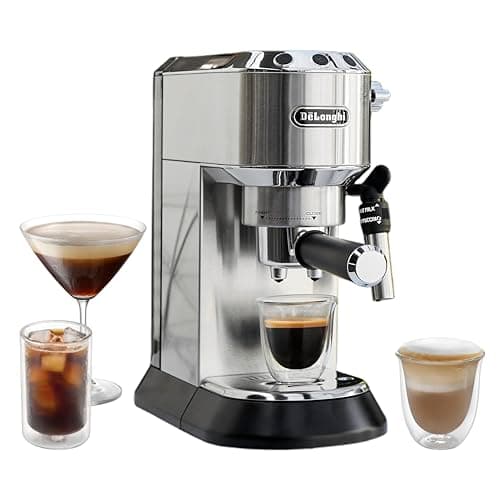
A Dedica-sized machine with a cold brew preset De'Longhi states finishes in under five minutes, alongside espresso and a steam wand.
Published specifications for the De'Longhi Dedica Duo (EC890M), with sources
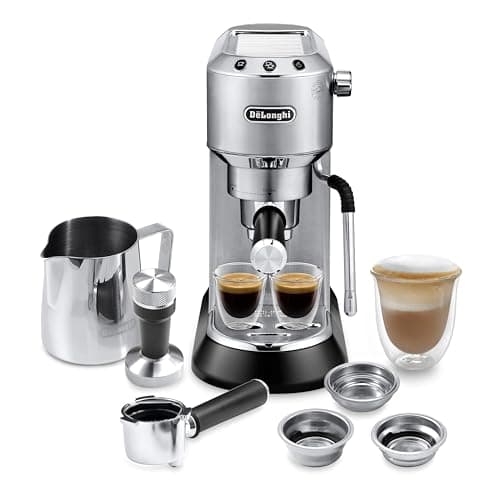
Portafilter, tamper, measuring scoop, single and double filter baskets [source]
Cold brew normally means 12 to 24 hours in the fridge. A five-minute cycle is a different process reaching a similar result, and the honest way to read it is as iced coffee that is smoother than pouring espresso over ice, not as identical to overnight cold brew.
Everything else here is the Dedica formula: a narrow body, a real portafilter and a steam wand you operate yourself.
De'Longhi publishes no pressure, tank capacity or dimensions for this model, which is a step backwards from what it publishes for the original Dedica.
What it does well
A cold brew preset built into an espresso machine
Ships with portafilter, tamper and both basket sizes
Steam wand rather than a panarello sleeve
What you give up
De'Longhi publishes no dimensions, tank capacity or pump pressure
No grinder
Five-minute cold brew is not the same process as overnight cold brew
Skip it if you drink iced coffee twice a summer. A jug in the fridge costs nothing, and the rest of this machine is available for less without the cold brew cycle.
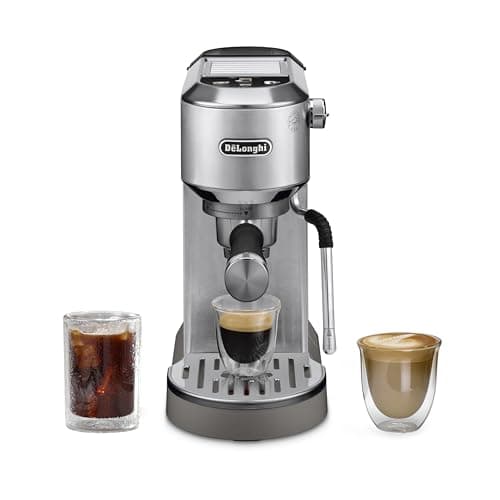
The middle Dedica: the narrow body with a My LatteArt steam wand instead of the older frothing attachment. De'Longhi no longer publishes a specification page for it.
We have not compiled a cited spec sheet for this pick yet, so there is no spec table here. What follows is about fit — who it is for and who it is not — not about numbers we cannot source. See how we pick.
The wand is the reason this model exists. A proper steam wand lets you texture milk yourself, which is the skill that separates a flat white from hot milk with bubbles on it — an older-style frothing attachment aerates for you and takes that control away.
De'Longhi US keeps a manuals and support page for this model but no longer a product page with specifications, so the figures other sites quote for it cannot be traced back to the manufacturer. We have left its spec table empty rather than repeat them.
Of the four Dedicas, this one currently has the strongest Amazon listing — new, in stock and sold by Amazon itself rather than a third party.
What it does well
A real steam wand in the narrow Dedica body
The best-supported listing of the four Dedicas
What you give up
De'Longhi publishes no specification page for it
Manual milk texturing is a skill with a real learning period
No grinder
Skip it if you want the milk handled for you — the Maestro Plus automates the wand, and a machine that stops on its own is the one that gets used on a weekday.
An automatic milk wand without leaving the Dedica line
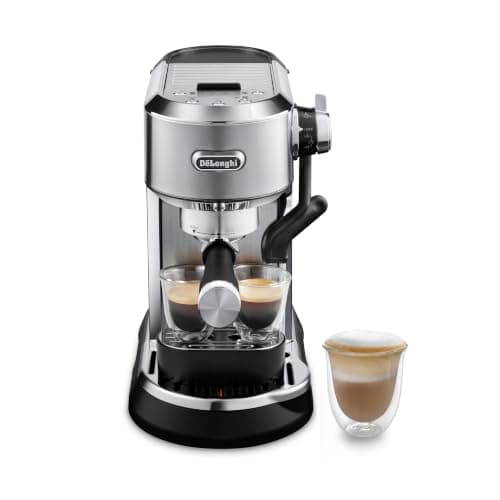
The top of the Dedica range: an automatic steam wand with three foam textures, three brew temperatures and a 20 g double basket — at the cost of the narrow body the line is known for.
Published specifications for the De'Longhi Dedica Maestro Plus (EC950M), with sources
A 20 g double basket is the specification that separates this from the rest of the line. It is a normal dose for a 54 mm or 58 mm machine and unusually generous for a Dedica, which means recipes written for other machines transfer more directly.
Three infusion temperatures is real control rather than a label: it is the adjustment you reach for when a bean tastes harsh at the default and you do not want to change the grind again.
At a stated 8.15 inches it is noticeably wider than the 6-inch Dedica the line built its reputation on. If you came to the Dedica name for the narrow body, this is not that machine.
What it does well
Automatic steam wand with three published foam textures
Three brew temperature settings
Ships with a real tamper and a milk jug
What you give up
Widest machine in the Dedica line, at a stated 8.15 inches
Still no grinder
Currently sold by third-party sellers rather than Amazon itself
Skip it if counter width is why you were looking at a Dedica at all. The whole point of the line is the narrow body, and this model trades it away.
Takes ground coffee (1 or 2 cups) and E.S.E. pods [source]
Milk
Adjustable frothing wand / cappuccino system [source]
Fifteen centimeters of width is genuinely unusual and it is why this machine keeps selling. If your counter run is already full, that number decides the purchase before any other spec does.
The E.S.E. pod compatibility is a fair hedge: it means the machine still makes a coffee on the day you have not restocked beans, without committing you to a pod ecosystem.
It uses a smaller basket than the 54 mm standard, so accessories and recipes written for 54 mm machines will not transfer directly.
What it does well
Fits where nothing else fits
Takes ground coffee or E.S.E. pods
Adjustable frothing wand rather than a fixed panarello
What you give up
Non-standard basket size limits accessory choice
Narrow body means a small water tank and frequent refills
Skip it if counter width is not actually your constraint — you are paying for the one thing it is best at and giving up basket standardization to get it.
Every other difference in this line is small next to this one, and it is the thing the model names hide completely.
Three generations of Dedica milk system
System
What it is
What you get
Adjustable cappuccino system (DeLuxe)
A frothing attachment that pulls in air as steam passes
Quick, foamy milk. Easy, and hard to make microfoam with
My LatteArt wand (Arte, Duo)
A bare steam wand you position yourself
Real microfoam is possible, and it is on you to learn it
Auto LatteArt (Maestro Plus)
An automatic wand with three published foam textures
Consistent milk with no technique — and no control either
If you drink flat whites and want them to look and taste like the cafe's, the bare wand on the Arte or Duo is the one to have — and how to steam milk is the hour that makes it work. If milk drinks are what you want and practice is not, the Maestro Plus does it for you. If you mostly drink espresso black, the DeLuxe's simpler attachment is not a limitation you will ever notice.
**A standard basket.** The Dedica line does not use the 54 mm or 58 mm sizes most accessories are made for, so check before buying a tamper or a bottomless portafilter. Portafilter sizes explained covers how to measure yours.
**A big water tank.** Only the Maestro Plus publishes a capacity, and a narrow machine holds less by definition. Expect refills.
**Published dimensions, mostly.** De'Longhi states 6 inches for the DeLuxe and 8.15 for the Maestro Plus and nothing for the middle two, which is awkward given width is the line's entire selling point.
E.S.E. pods, and who actually wants them
De'Longhi states E.S.E. pod compatibility for the DeLuxe, and it is the one feature in this line that people either ignore completely or buy the machine for.
An E.S.E. pod is a pre-measured paper-wrapped puck of ground coffee, tamped at the factory, that drops into a dedicated filter basket. You get a consistent shot with no grinder, no dosing and no tamping — and no control over any of it, plus an ongoing cost per cup that loose beans do not have.
The honest use for it is as a hedge rather than a habit: it means the machine still makes a coffee on the morning you have run out of beans or have a guest who wants one drink. What it is not is a reason to skip the grinder, because a machine run on pods is a machine you never learn anything on. It is also a small and shrinking format compared with capsules, so check pods are easy to buy where you live before it influences the purchase.
Living with a narrow machine
Two practical consequences of the shape, neither of which appears on a spec sheet.
**The tank is small, so you refill often.** A six-inch-wide body has nowhere to put a large reservoir. De'Longhi publishes a capacity only for the Maestro Plus, at 54 oz, and that is the widest machine in the line — assume the narrower ones hold less. If you make several milk drinks in a row, that is a refill mid-session.
**Cup clearance is tight.** Narrow machines are usually short machines, and the gap between the spout and the drip tray decides whether your travel mug fits. No maker publishes it. Check whether the tray lifts out or has a raised position before you buy, because that is the feature that solves it.
Is the cold brew on the Duo worth it?
It is the Duo's one genuine addition, and De'Longhi states it finishes in under five minutes against the twelve or more hours a jug in the fridge takes.
Read that as a convenience claim rather than an equivalence claim: a five-minute cycle replaces time with pressure and agitation, so the result is smoother than espresso poured over ice without being identical to an overnight steep. Worth having if you drink cold coffee most days; not worth choosing the machine for if you drink it in July. Espresso machines for iced coffee and cold brew works through the whole category.
So which one
**For most buyers, the Duo.** It is in the current lineup, it has the proper steam wand, it ships with a tamper and both baskets, and the cold brew cycle is a real feature rather than a badge.
**Buy the Arte instead** if you want the same wand without paying for a cold brew cycle you will not use — its listing is the best supported of the four, sold by Amazon itself.
**Buy the Maestro Plus** only for the automatic wand and the three brew temperatures, and only if you have the extra counter width. You are paying for automation, not for a better shot.
**Buy the DeLuxe** if six inches is a hard constraint. It remains the narrowest machine in the line and the reason the Dedica has the reputation it does — just go in knowing it is no longer in De'Longhi's current Dedica listing.
And if you are not yet committed to the Dedica name at all, De'Longhi for beginners weighs it against the rest of the range, and De'Longhi vs Breville is the cross-brand version of the same question.
We have not used any of these machines. Every figure above is published by De'Longhi and linked below, and prices come live from the listing we link to.
Questions people actually ask
What is the difference between the De'Longhi Dedica models?+−
Mainly the milk system. The DeLuxe has an adjustable cappuccino frothing attachment, the Arte and Duo have a My LatteArt steam wand you control yourself, and the Maestro Plus has an automatic Auto LatteArt wand with three stated foam textures. The Duo adds a cold brew cycle; the Maestro Plus adds three brew temperatures and a 20 g dose.
Which Dedica models does De'Longhi still sell?+−
De'Longhi's current Dedica category lists the Duo and the Maestro Plus. The DeLuxe and the Arte are still sold new by retailers and still have pages or support entries on De'Longhi's site, but they are not in that current listing.
Is the Dedica Maestro Plus still a compact machine?+−
Less so. De'Longhi states 8.15 inches wide for the Maestro Plus against 6 inches for the DeLuxe — around a third wider. If you are buying a Dedica specifically because of a narrow counter, measure against the model rather than the name.
Do De'Longhi Dedica machines come with a grinder?+−
No. None of the four has a built-in grinder, so budget for one in the same purchase. Espresso needs a grind finer and more adjustable than pre-ground coffee provides.
Does the Dedica use a 54 mm portafilter?+−
No. The Dedica line does not use the 54 mm or 58 mm sizes most accessories are made for, so measure your basket before buying a tamper, a distribution tool or a bottomless portafilter.
Is the Dedica Duo's cold brew real cold brew?+−
It is a fast machine cycle rather than an overnight steep — De'Longhi states under five minutes. The result is smoother than espresso poured over ice, and it is not the same process as a twelve-hour cold steep. No maker claims it is.