Heads up: we earn a commission if you buy through the links on this page, at no extra cost to you. It never changes the order of the list. Full disclosure · how we pick.
Dialing in means adjusting your setup until the shot tastes good and does so repeatably. It sounds like a dark art and it is a procedure. The whole thing rests on one discipline: **fix everything, move one thing.**
Fix these two, then leave them alone
**Dose.** Whatever your basket is designed for — 18 g on most standard doubles. Weigh it every time.
**Yield.** Twice the dose. 18 g in, 36 g out, which is the 1:2 ratio the National Coffee Association describes.
With those two fixed, time becomes a **measurement** rather than a target. You are not trying to make the shot take 27 seconds; you are observing how long it takes to reach 36 g, and using that as feedback about the grind.
Quick picks — How to dial in espresso
#
Pick
Best for
Type
Price
1
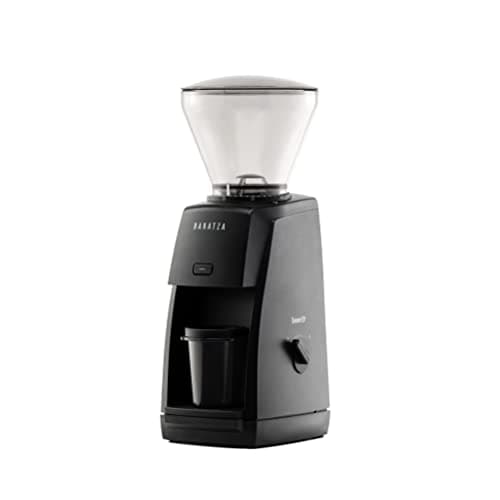
Baratza Encore ESPTop pickAn Encore reworked for espresso: the first 20 clicks are a fine, high-resolution espresso range, and the remaining 20 cover filter.
We have not handled these units. Everything above comes from published manufacturer documentation, cited inline, plus arithmetic you can redo yourself. Everyone in this category says they tested twenty machines; we have not tested any, and we say so. Here is what we do instead.
01
Baratza Encore ESP
The default first electric grinder
An Encore reworked for espresso: the first 20 clicks are a fine, high-resolution espresso range, and the remaining 20 cover filter.
Published specifications for the Baratza Encore ESP, with sources
Burr
40 mm M2 conical, quick-release for cleaning [source]
Grind range
#1-20 optimized for espresso in fine steps; #21-40 for filter [source]
Burr speed
550 RPM, reduced to limit heat, noise and static [source]
Twenty fine clicks inside the espresso range is the specification that matters. Grinders that give you five usable espresso settings cannot be dialed in; this one can.
550 RPM is deliberately slow. Slower burrs mean less heat and less static, which in practice means less ground coffee stuck to the inside of the chute and thrown around your counter.
It ships with both 54 mm and 58 mm dosing, which covers a Breville and a Gaggia without buying anything else.
What it does well
Genuine fine adjustment across the espresso range
Covers filter grinding too, so it is not a single-purpose purchase
Quick-release burr makes cleaning a two-minute job
Fits both common portafilter sizes out of the box
What you give up
Retains some grounds between doses, like most hoppered grinders
Louder than a hand grinder, obviously
Skip it if you already have a capable hand grinder and only make one or two drinks a day — you would be buying convenience, not better coffee.
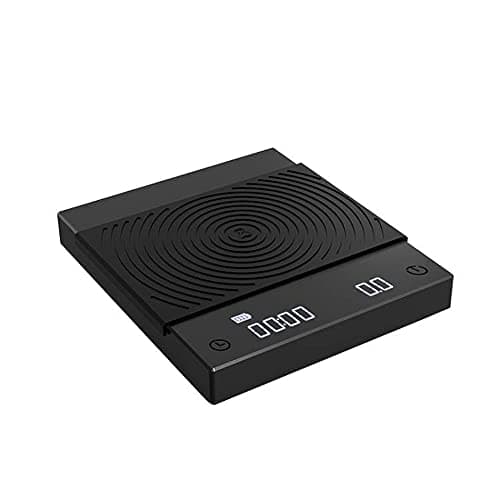
A 0.1 g coffee scale with a built-in timer, small enough to sit under a cup on the drip tray.
We have not compiled a cited spec sheet for this pick yet, so there is no spec table here. What follows is about fit — who it is for and who it is not — not about numbers we cannot source. See how we pick.
Espresso needs 0.1 g resolution because the dose is around 18 g and a gram either way changes the shot noticeably.
The timer matters as much as the weight. The National Coffee Association puts espresso brewing at 20-30 seconds, and you cannot hit a window you are not measuring.
What it does well
0.1 g resolution, which is the actual requirement
Timer built in, so you are not juggling a phone
Small enough to fit under the portafilter on most machines
What you give up
Not waterproof — it lives on a drip tray, so wipe it
No flow-rate display
Skip it only if your machine already weighs the dose for you. Otherwise this is the cheapest thing on the whole list that changes the coffee.
Grind 18 g. Prepare the puck the same way every time.
Pull to 36 g, timing from when the pump starts.
**If it took under 20 seconds:** grind finer. Repeat.
**If it took over 30 seconds:** grind coarser. Repeat.
**If it took 20-30 seconds:** stop adjusting the grind and taste it.
**Sour or sharp:** slightly finer.
**Bitter or drying:** slightly coarser.
**Balanced and sweet:** you are done. Write the setting down.
Most people converge in three to five shots on a grinder with countable clicks. On a grinder without them it takes longer, because you cannot return to a setting reliably — see stepped versus stepless.
Keep a log. Three columns is enough.
The whole log, and what it teaches you
Bean
Grind setting
In / Out / Time
Taste
Blend A, roasted 12 Aug
8
18 / 36 / 22 s
Sour, thin
Blend A, roasted 12 Aug
7
18 / 36 / 26 s
Better, still sharp
Blend A, roasted 12 Aug
6
18 / 36 / 29 s
Balanced. Keep.
Blend A, roasted 12 Aug
6
18 / 36 / 32 s
Slow — bag is 3 weeks old now
That last row is the reason the log is worth keeping. The same setting drifting slower over weeks is the bag aging, not you getting worse — fresh coffee holds more gas and resists more, so a setting that was right on day five runs differently on day twenty-five.
When to change something other than grind
The other variables, in the order to reach for them
Variable
Reach for it when
Effect
Grind
Always first
The main control over flow rate
Dose
One grind click is too big a jump
+1 g slows the shot; -1 g speeds it up
Yield
The shot is balanced but too intense or too weak
More yield is weaker and sweeter; less is stronger and sharper
Temperature
Only on a machine that lets you set it, and only last
Higher extracts more; useful on light roasts
Puck prep
The shot sprays or times vary wildly between attempts
**A new bag of beans.** Always. Even the same blend from the same roaster.
**A bag that has aged past about three weeks.** It will run slower at the same setting.
**Switching to or from decaf.** Decaf is more brittle and grinds finer — see decaf.
**After cleaning the grinder burrs**, if you took them out.
**A significant change in humidity.** Less common, and real.
Questions people actually ask
How do you dial in espresso?+−
Fix the dose and the yield — typically 18 g in and 36 g out — then adjust only the grind until that takes 20 to 30 seconds. Once you are inside that window, adjust by taste: sour means finer, bitter means coarser.
How many shots does it take to dial in?+−
Usually three to five on a grinder with countable adjustment steps. It takes longer on a grinder where you cannot return to a setting reliably.
Do I need to dial in every new bag?+−
Yes. Different beans, different roast levels and different roast dates all behave differently at the same grinder setting. The same bag also drifts slower as it ages.
Should I change grind or dose first?+−
Grind, always. It is the main control over flow rate. Reach for dose only when one grind click is too big a jump between too fast and too slow.
What if my shot is the right time but still tastes bad?+−
Then adjust by taste in small steps: sour means slightly finer, bitter means slightly coarser. If neither helps, check bean freshness and clean the machine before changing anything else.