Heads up: we earn a commission if you buy through the links on this page, at no extra cost to you. It never changes the order of the list. Full disclosure · how we pick.
**Short answer:** no, you cannot use a blade grinder for espresso. A blade grinder chops beans with a spinning blade, producing a mixture of powder and chunks in the same batch. Espresso needs particles of a consistent size, because water takes the path of least resistance — it runs through the coarse pieces, past the fine ones, and out in eight seconds tasting sour and thin. Grinding longer makes more powder without removing the chunks. If yours is a burr grinder bought for filter coffee, the answer is less clear-cut — can you use a regular coffee grinder for espresso has the test to run before you buy anything.
A burr grinder crushes beans between two surfaces set a fixed distance apart. Nothing gets through until it is smaller than that gap, which is what produces a consistent size — and lets you change the size by changing the gap.
How to tell what you own, in thirty seconds
Open the lid. If you see a propeller-shaped blade in the bottom of the chamber, it is a blade grinder.
If you see a ring with teeth or ridges, or a cone sitting inside a ring, it is a burr grinder.
If it is a burr grinder, find the adjustment. Count the settings, and count how many of them sit at the fine end. Fewer than about ten usable steps at the fine end means espresso adjustment will be a jump, not a nudge.
Look for the words "espresso" and "Turkish" grouped as a single setting. That grouping usually means the finest setting is a destination rather than a range.
Quick picks — Burr vs blade grinder for espresso
#
Pick
Best for
Type
Price
1
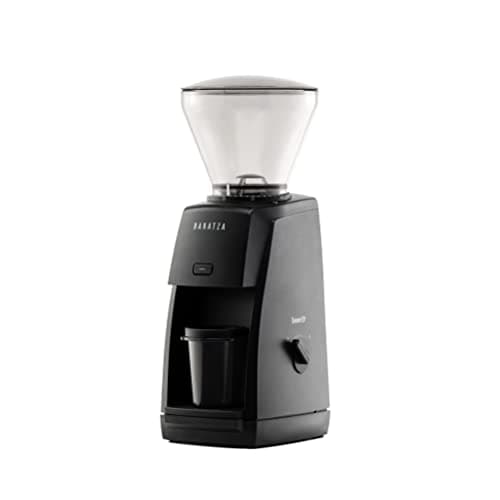
Baratza Encore ESPTop pickAn Encore reworked for espresso: the first 20 clicks are a fine, high-resolution espresso range, and the remaining 20 cover filter.
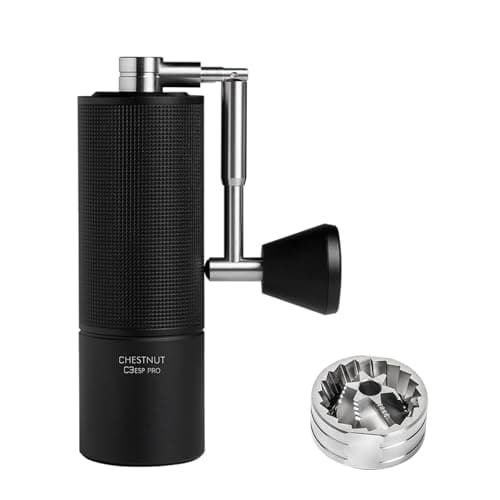
Timemore Chestnut C3 ESP ProThe usual answer to “what is the least I can spend on a grinder that actually works for espresso” — an espresso-tuned version of a very common entry hand grinder.
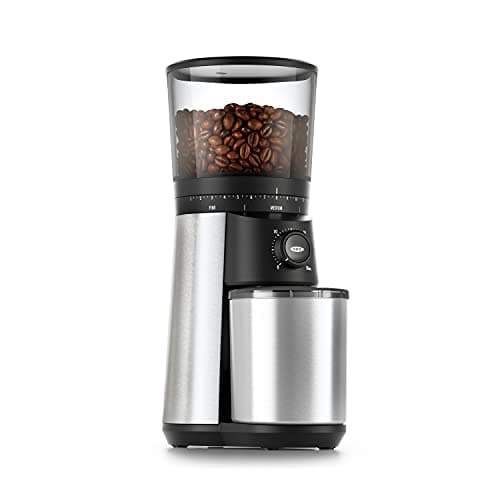
OXO Brew Conical Burr GrinderA good, widely recommended filter grinder that is regularly bought for espresso by mistake. It is not built to go that fine.
We have not handled these units. Everything above comes from published manufacturer documentation, cited inline, plus arithmetic you can redo yourself. Everyone in this category says they tested twenty machines; we have not tested any, and we say so. Here is what we do instead.
01
Baratza Encore ESP
The default first electric grinder
An Encore reworked for espresso: the first 20 clicks are a fine, high-resolution espresso range, and the remaining 20 cover filter.
Published specifications for the Baratza Encore ESP, with sources
Burr
40 mm M2 conical, quick-release for cleaning [source]
Grind range
#1-20 optimized for espresso in fine steps; #21-40 for filter [source]
Burr speed
550 RPM, reduced to limit heat, noise and static [source]
Twenty fine clicks inside the espresso range is the specification that matters. Grinders that give you five usable espresso settings cannot be dialed in; this one can.
550 RPM is deliberately slow. Slower burrs mean less heat and less static, which in practice means less ground coffee stuck to the inside of the chute and thrown around your counter.
It ships with both 54 mm and 58 mm dosing, which covers a Breville and a Gaggia without buying anything else.
What it does well
Genuine fine adjustment across the espresso range
Covers filter grinding too, so it is not a single-purpose purchase
Quick-release burr makes cleaning a two-minute job
Fits both common portafilter sizes out of the box
What you give up
Retains some grounds between doses, like most hoppered grinders
Louder than a hand grinder, obviously
Skip it if you already have a capable hand grinder and only make one or two drinks a day — you would be buying convenience, not better coffee.
The usual answer to “what is the least I can spend on a grinder that actually works for espresso” — an espresso-tuned version of a very common entry hand grinder.
We have not compiled a cited spec sheet for this pick yet, so there is no spec table here. What follows is about fit — who it is for and who it is not — not about numbers we cannot source. See how we pick.
The ESP suffix on a hand grinder means the adjustment has been rescaled so the espresso range occupies more of the dial, not that the burrs are different in kind.
This is the floor of the honest answer. Below it, you are buying a grinder that cannot reach espresso fineness with any consistency, whatever the listing claims.
What it does well
The lowest price that still gives usable espresso adjustment
Small, quiet, nothing to plug in
What you give up
Small capacity
Manual effort daily
Skip it if you drink more than a couple of doubles a day, or if the grinding step is the part you were hoping to avoid.
A good, widely recommended filter grinder that is regularly bought for espresso by mistake. It is not built to go that fine.
We have not compiled a cited spec sheet for this pick yet, so there is no spec table here. What follows is about fit — who it is for and who it is not — not about numbers we cannot source. See how we pick.
This grinder appears in a lot of “best coffee grinder” lists that are not about espresso. Those lists are right; the mismatch happens when a first-time espresso buyer reads them.
A grinder that cannot reach espresso fineness produces a fast, thin, sour shot no matter what you do with dose and tamp. The fix is the grinder, every time.
What it does well
Genuinely good at filter grinding
Widely available and well supported
What you give up
Not intended for espresso, and it shows immediately
Skip it for espresso, full stop. If you already own one, keep it for filter and buy an espresso-capable grinder alongside it.
Blade against burr, on what actually happens in the cup
Blade
Burr
Mechanism
Chops with a spinning blade
Crushes between two surfaces at a set gap
Consistency
Powder and chunks together
One size, set by the gap
Adjustment
Grind longer — makes more powder, same chunks
Move the burrs closer or further apart
Espresso
Not possible
Possible if it goes fine enough
Filter coffee
Acceptable
Better
Cost
Very cheap
From about $60 manual
The trap: a good burr grinder that is still wrong
Plenty of well-reviewed burr grinders are on this page's third pick for a reason. They are genuinely excellent at filter grinding, they appear in every "best coffee grinder" list, and those lists are not about espresso. A grinder whose finest setting is still coarser than espresso needs will produce a fast, weak shot forever, and no dose or tamp change will fix it. Check the grinder's espresso range specifically, not its reviews generally.
Questions people actually ask
Can you use a blade grinder for espresso?+−
No. A blade grinder produces powder and chunks in the same batch, and water runs through the chunks rather than extracting evenly. The result is a fast, sour shot no technique can fix.
Can I use a regular coffee grinder for espresso?+−
Only if it is a burr grinder that reaches espresso fineness with fine adjustment. Many burr grinders sold for drip coffee do not, and they are the most common disappointment in a first setup.
What kind of grinder is best for espresso?+−
A burr grinder — conical or flat — with a high-resolution adjustment range at the fine end. Baratza states 20 fine clicks inside the espresso range on the Encore ESP, which is the specification shape to look for.
Does it matter for filter coffee too?+−
It matters less, because filter brewing is far more forgiving of uneven grounds. A blade grinder makes acceptable French press coffee and unacceptable espresso.