Heads up: we earn a commission if you buy through the links on this page, at no extra cost to you. It never changes the order of the list. Full disclosure · how we pick.
You already own a coffee grinder. It cost a fair amount, it makes good filter coffee, and you would rather not buy another one. Can it make espresso?
**Usually no, and occasionally yes.** The answer turns on a property most product pages do not advertise, so this page explains what to look for and gives you a test you can run this morning with the equipment on your counter.
First, the easy case: is it a blade grinder?
If your grinder has a spinning blade in a chamber and you control the grind by how long you hold the button, the answer is a flat no — not “not ideal”, but no. A blade chops rather than mills, and produces a mix of dust and chunks simultaneously. Espresso needs the particles to be similar in size, because water at pressure will always find the easiest path through the puck. Burr vs blade covers how to tell in thirty seconds what you own.
If it is a burr grinder, read on, because that is where the interesting answer lives.
The real problem is step size, not fineness
Most decent filter burr grinders can physically grind fine. That is not the obstacle. The obstacle is how far the grinder moves between one setting and the next.
Espresso is brewed against pressure, so the grind controls how fast water gets through the coffee, and the useful adjustment range is narrow. You are looking for a change small enough to move a shot from 20 seconds to 28 seconds. A grinder built for filter coffee spreads its settings across a much wider range — from espresso to French press — so each click moves you further than the entire espresso window.
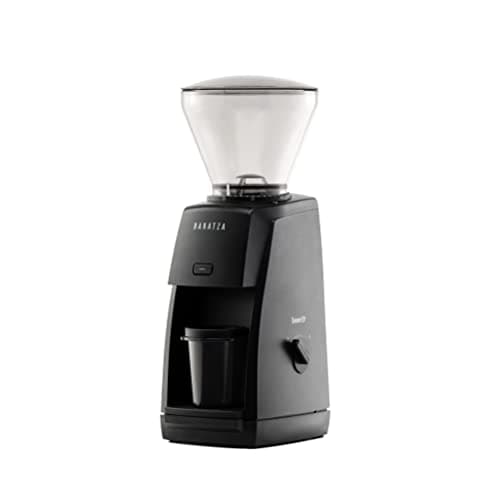
Here is what purpose-built resolution looks like when a manufacturer publishes it: Baratza states that the Encore ESP dedicates settings #1-20 to espresso in fine steps, with #21-40 covering filter. Same machine shape as its filter sibling, redistributed so that most of the dial lives where espresso needs it. A filter grinder gives the espresso range perhaps three or four usable clicks in total.
The one-shot test
Before buying anything, run this. It takes one morning and it answers the question properly.
**Set your grinder to its finest setting** and grind a dose for your basket — Breville states 18 g for its 54 mm baskets, so use what your machine states.
**Pull a shot and time it** from the moment the pump starts. You are aiming for roughly 25 to 30 seconds for a double.
**If it runs out in under 15 seconds at the finest setting**, your grinder cannot go fine enough. That is a hard stop and no technique fixes it.
**If it chokes and barely drips**, go one click coarser and try again. If the very next click gushes, you have found the step-size problem — the grinder can reach espresso but cannot be adjusted within it.
**If you land between 25 and 30 seconds and can move the shot a couple of seconds with one click**, your grinder works. Keep it, and spend the money on beans instead.
Quick picks — Can you use a regular coffee grinder for espresso?
#
Pick
Best for
Type
Price
1
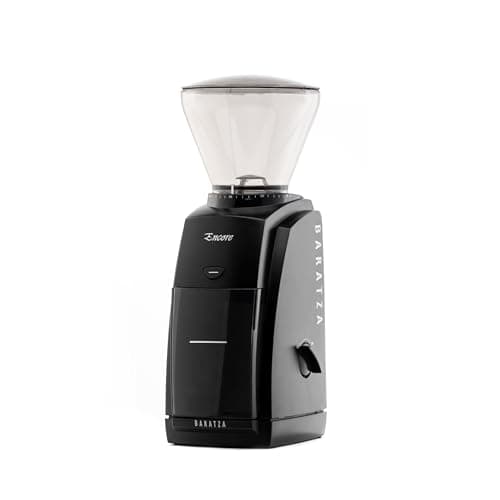
Baratza Encore ESPTop pickAn Encore reworked for espresso: the first 20 clicks are a fine, high-resolution espresso range, and the remaining 20 cover filter.
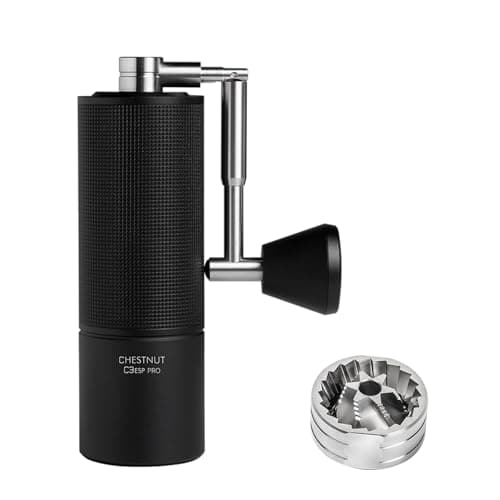
Timemore Chestnut C3 ESP ProThe usual answer to “what is the least I can spend on a grinder that actually works for espresso” — an espresso-tuned version of a very common entry hand grinder.
Baratza EncoreThe long-standing filter-grinder recommendation. It is listed here so you do not buy it by mistake: the ESP is the espresso version for a reason.
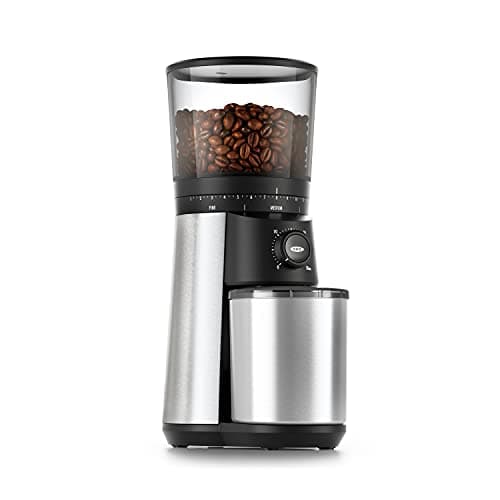
OXO Brew Conical Burr GrinderA good, widely recommended filter grinder that is regularly bought for espresso by mistake. It is not built to go that fine.
We have not handled these units. Everything above comes from published manufacturer documentation, cited inline, plus arithmetic you can redo yourself. Everyone in this category says they tested twenty machines; we have not tested any, and we say so. Here is what we do instead.
01
Baratza Encore ESP
The default first electric grinder
An Encore reworked for espresso: the first 20 clicks are a fine, high-resolution espresso range, and the remaining 20 cover filter.
Published specifications for the Baratza Encore ESP, with sources
Burr
40 mm M2 conical, quick-release for cleaning [source]
Grind range
#1-20 optimized for espresso in fine steps; #21-40 for filter [source]
Burr speed
550 RPM, reduced to limit heat, noise and static [source]
Twenty fine clicks inside the espresso range is the specification that matters. Grinders that give you five usable espresso settings cannot be dialed in; this one can.
550 RPM is deliberately slow. Slower burrs mean less heat and less static, which in practice means less ground coffee stuck to the inside of the chute and thrown around your counter.
It ships with both 54 mm and 58 mm dosing, which covers a Breville and a Gaggia without buying anything else.
What it does well
Genuine fine adjustment across the espresso range
Covers filter grinding too, so it is not a single-purpose purchase
Quick-release burr makes cleaning a two-minute job
Fits both common portafilter sizes out of the box
What you give up
Retains some grounds between doses, like most hoppered grinders
Louder than a hand grinder, obviously
Skip it if you already have a capable hand grinder and only make one or two drinks a day — you would be buying convenience, not better coffee.
The usual answer to “what is the least I can spend on a grinder that actually works for espresso” — an espresso-tuned version of a very common entry hand grinder.
We have not compiled a cited spec sheet for this pick yet, so there is no spec table here. What follows is about fit — who it is for and who it is not — not about numbers we cannot source. See how we pick.
The ESP suffix on a hand grinder means the adjustment has been rescaled so the espresso range occupies more of the dial, not that the burrs are different in kind.
This is the floor of the honest answer. Below it, you are buying a grinder that cannot reach espresso fineness with any consistency, whatever the listing claims.
What it does well
The lowest price that still gives usable espresso adjustment
Small, quiet, nothing to plug in
What you give up
Small capacity
Manual effort daily
Skip it if you drink more than a couple of doubles a day, or if the grinding step is the part you were hoping to avoid.
The long-standing filter-grinder recommendation. It is listed here so you do not buy it by mistake: the ESP is the espresso version for a reason.
We have not compiled a cited spec sheet for this pick yet, so there is no spec table here. What follows is about fit — who it is for and who it is not — not about numbers we cannot source. See how we pick.
The standard Encore and the Encore ESP look alike and cost differently. The ESP exists because the standard model's adjustment range was not built to sit in the espresso zone.
If you also brew pour-over or French press, the standard model is excellent at that job and the wrong tool for this one.
What it does well
Well-supported, repairable, widely stocked
Excellent for filter brewing
What you give up
Not built for the espresso grind range — that is what the ESP is for
Skip it if espresso is the reason you are buying a grinder. Buy the ESP instead; this is the same family aimed at a different brew method.
A good, widely recommended filter grinder that is regularly bought for espresso by mistake. It is not built to go that fine.
We have not compiled a cited spec sheet for this pick yet, so there is no spec table here. What follows is about fit — who it is for and who it is not — not about numbers we cannot source. See how we pick.
This grinder appears in a lot of “best coffee grinder” lists that are not about espresso. Those lists are right; the mismatch happens when a first-time espresso buyer reads them.
A grinder that cannot reach espresso fineness produces a fast, thin, sour shot no matter what you do with dose and tamp. The fix is the grinder, every time.
What it does well
Genuinely good at filter grinding
Widely available and well supported
What you give up
Not intended for espresso, and it shows immediately
Skip it for espresso, full stop. If you already own one, keep it for filter and buy an espresso-capable grinder alongside it.
It is not cost-cutting. A grinder sold for filter coffee has to cover French press at one end and pour-over at the other, and that is a wide span of particle sizes. Spreading forty clicks across it is the correct design for that job.
Espresso is the opposite problem: one narrow band, explored in tiny increments. The National Coffee Association describes espresso as a fine grind brewed under pressure in 20 to 30 seconds, and landing in that window repeatably is what the adjustment mechanism has to allow. A grinder can be well made, expensive and genuinely excellent at filter coffee and still be the wrong tool here. That is not a quality judgment about your grinder.
It also explains why some makers sell two versions of what looks like the same grinder. Baratza's Encore and Encore ESP share a body; the ESP redistributes the range so most of the dial sits in espresso territory. Same machine, different job.
What about buying pre-ground espresso instead?
It is the obvious workaround and it deserves a straight answer rather than snobbery: **you can, and it will be worse, and for some people that is a fine trade.**
Two things go wrong. The first is that coffee ground for espresso is ground very fine, which exposes enormous surface area to air — the National Coffee Association puts ground coffee's useful window at one to two weeks, against one to three for whole beans at room temperature. A bag opened on the first of the month is noticeably flat by the middle of it.
The second is that you cannot adjust it. Everything that goes wrong with an espresso shot is normally fixed by moving the grind finer or coarser, and with pre-ground that control does not exist. If the shot runs fast, your options are to change the dose, change the bag, or accept it.
Where it genuinely works: a machine with a pressurized basket, a drinker who takes milk, and a household that gets through a bag quickly. Where it does not: anyone with a single-wall basket, or anyone who wants the shot to improve. Are supermarket beans good enough covers the same trade on the bean side, and do I need a grinder for espresso? is the version of this question for someone who owns no grinder at all.
Signs your grinder is at its limit
**The finest setting still gushes.** A hard stop — it cannot go fine enough, and nothing downstream fixes that.
**The burrs chirp before you get there.** A grinding or squealing noise at the finest settings means the burrs are touching. Back off; running them in contact wears them out.
**Every click is a different drink.** Fourteen seconds, then forty. You are stepping over the window rather than into it.
**Shot time drifts within one bag.** Beans degas for days after roasting, and a grinder with coarse steps cannot follow them, so Monday's setting is wrong by Friday.
**Grounds clump and stick.** Static and clumping get worse at espresso fineness, and a grinder not designed for it has no chute geometry to cope. Puck prep covers what to do about clumps whatever you own.
If it passes, change two things anyway
A filter grinder that clears the bar will still behave differently from a purpose-built one, in two ways worth compensating for.
**Weigh the dose rather than timing it.** Filter grinders dose by time far more often, and time drifts as beans age and as burrs season. A scale removes the variable — see scales with a timer.
**Purge after every adjustment.** Coffee sits in the chute of any grinder, so the first few grams after a change are still the old setting. On a grinder not built for single dosing that residue is larger, and it will convince you an adjustment did nothing. Single dosing explains the problem and whether it is worth solving.
What about a pressurized basket?
If your machine came with a dual-wall or pressurized basket, it will produce crema and a plausible-looking shot from a coarser, less even grind, because the basket restricts flow instead of the coffee doing it. That genuinely widens what a filter grinder can get away with.
It is a real answer, not a cheat — a lot of people drink perfectly good coffee this way for years. Just know that it sets a ceiling: the day you switch to a single-wall basket, the grinder question comes back immediately, because now the coffee has to create the resistance.
If it fails the test
Two honest options, in this order.
**A hand grinder.** The cheapest route to a genuinely espresso-capable grind, because you are not paying for a motor. It lives in a drawer and costs you effort every morning. See hand grinders.
**An espresso-specific electric.** More money, no effort, and the adjustment range is where you need it. See grinders under $200.
Keep the old grinder either way. It is still a good filter grinder, and running espresso beans through a dedicated espresso grinder while leaving the filter one alone means neither has to be readjusted every time you change drinks.
We have not used this equipment. Where a figure appears above it is published by the manufacturer and linked below, and prices come live from the listings we link to.
Questions people actually ask
Can you use a regular coffee grinder for espresso?+−
Sometimes, if it is a burr grinder that goes fine enough and adjusts in small enough steps. Most grinders built for filter coffee spread their settings across too wide a range, so a single click jumps past the whole espresso window. A blade grinder cannot do it at all.
Do you need a special grinder for espresso?+−
You need one whose adjustment steps are small in the espresso range. That is what espresso-specific grinders provide — Baratza, for example, states that the Encore ESP puts settings #1-20 in the espresso range with fine steps and #21-40 for filter.
How do I know if my grinder is fine enough for espresso?+−
Set it to its finest setting, grind your machine's stated dose and time the shot. If a double runs out in under 15 seconds at the finest setting, the grinder cannot go fine enough. If it chokes at one setting and gushes at the next, the steps are too big.
Can I use a blade grinder for espresso?+−
No. A blade chops rather than mills and produces dust and chunks at the same time, so water at pressure channels through the puck. This is the one case with no workaround.
Does grinding for longer make the coffee finer?+−
Only on a blade grinder, and that is the problem — grinding longer there produces more dust alongside the same chunks rather than an evenly finer grind. On a burr grinder the particle size is set by the gap between the burrs, so running it longer just grinds more coffee at the same setting.
Will a pressurized basket let me use my filter grinder?+−
Largely, yes. A dual-wall basket restricts flow itself, so it tolerates a coarser and less even grind. The limitation returns the moment you move to a single-wall basket, where the coffee has to create the resistance.