Heads up: we earn a commission if you buy through the links on this page, at no extra cost to you. It never changes the order of the list. Full disclosure · how we pick.
A hand grinder is the highest grind quality per dollar in home coffee, by a wide margin. There is no motor to pay for, no housing to make quiet, and the money goes almost entirely into the burrs and the shaft that holds them steady. What you pay instead is effort, and the honest question is how much of it you will accept every day. No motor also means no noise, which is why hand grinders lead quiet espresso setups.
Quick picks — Hand grinders for espresso
#
Pick
Best for
Type
Price
1
No photo
1Zpresso JX-ProTop pickBigger, heavier and higher-capacity than the Q2, with the adjustment resolution that makes espresso dial-in on a hand grinder realistic.
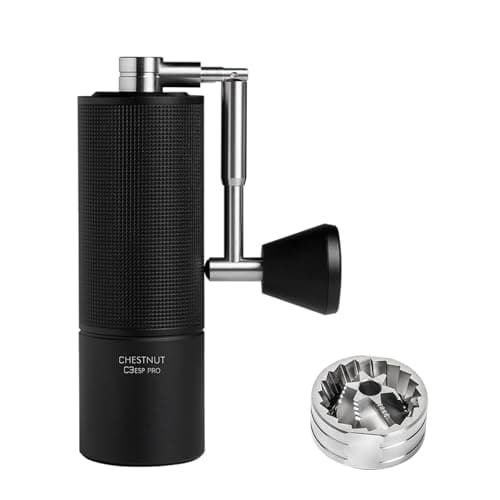
Timemore Chestnut C3 ESP ProThe usual answer to “what is the least I can spend on a grinder that actually works for espresso” — an espresso-tuned version of a very common entry hand grinder.
We have not handled these units. Everything above comes from published manufacturer documentation, cited inline, plus arithmetic you can redo yourself. Everyone in this category says they tested twenty machines; we have not tested any, and we say so. Here is what we do instead.
01No photo
1Zpresso JX-Pro
A hand grinder you will not replace
Bigger, heavier and higher-capacity than the Q2, with the adjustment resolution that makes espresso dial-in on a hand grinder realistic.
Published specifications for the 1Zpresso JX-Pro, with sources
The usual answer to “what is the least I can spend on a grinder that actually works for espresso” — an espresso-tuned version of a very common entry hand grinder.
We have not compiled a cited spec sheet for this pick yet, so there is no spec table here. What follows is about fit — who it is for and who it is not — not about numbers we cannot source. See how we pick.
The ESP suffix on a hand grinder means the adjustment has been rescaled so the espresso range occupies more of the dial, not that the burrs are different in kind.
This is the floor of the honest answer. Below it, you are buying a grinder that cannot reach espresso fineness with any consistency, whatever the listing claims.
What it does well
The lowest price that still gives usable espresso adjustment
Small, quiet, nothing to plug in
What you give up
Small capacity
Manual effort daily
Skip it if you drink more than a couple of doubles a day, or if the grinding step is the part you were hoping to avoid.
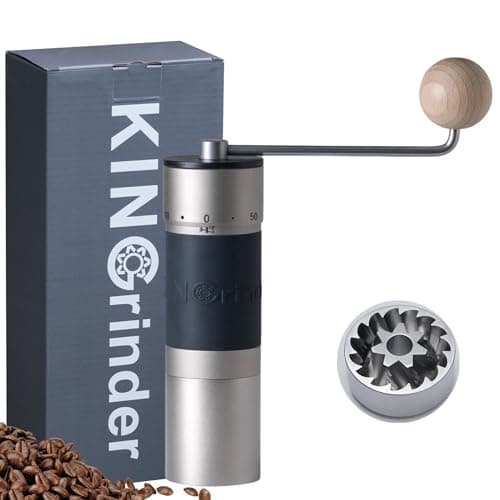
An external-adjustment hand grinder aimed squarely at espresso, from the value end of the market.
We have not compiled a cited spec sheet for this pick yet, so there is no spec table here. What follows is about fit — who it is for and who it is not — not about numbers we cannot source. See how we pick.
External adjustment means you change the grind without taking the grinder apart or losing your setting, which is the difference between dialing in and guessing.
This category exists because espresso needs adjustment steps small enough that a five-position dial is useless.
What it does well
External adjustment you can count and return to
Espresso-focused rather than filter-first
What you give up
Manual effort
Less established support than the bigger names
Skip it if you want the shortest path to a working setup with no research — a well-known electric grinder is the lower-effort answer.
It sounds trivial and it is not. 1Zpresso states 15 to 20 g of grounds capacity on the Q2 and 30 to 35 g on the JX-Pro. An 18 g double shot fits in the Q2 once. Two doubles need two fills, two grinds and two transfers — which is the difference between a hand grinder being a pleasure and being an obstacle in a two-person household.
Published figures, from 1Zpresso's own product pages
Q2
JX-Pro
Weight
475 g
778 g
Dimensions
14.5 × 15 × 4.6 cm
19 × 6.3 × 18 cm
Grounds capacity
15-20 g
30-35 g
Doubles per fill
One
Two
Best for
Travel, one drink a day
A daily home grinder
External adjustment is worth paying for
Cheap hand grinders adjust with a nut under the burrs, which means taking the grinder apart to change the setting and losing your reference point every time. Espresso-focused models put a numbered dial on the outside, so you can count clicks, write down what worked, and come back to it. That is the difference between dialing in and guessing.
Cleaning, and why the design matters
Coffee oils build up on burrs and go rancid, and that taste ends up in every shot afterward. 1Zpresso states the Q2 disassembles without tools and that reassembly keeps the burr calibration — which is exactly the feature that decides whether you actually clean it or keep meaning to.
Questions people actually ask
Are hand grinders good enough for espresso?+−
Yes, and at the same price they usually grind better than electric ones because all the money goes into the burrs. The limits are capacity and effort, not quality.
How much coffee does a hand grinder hold?+−
It varies by model. 1Zpresso states 15 to 20 g for the Q2 and 30 to 35 g for the JX-Pro — one double shot and two respectively at an 18 g dose.
Are hand grinders hard work for espresso?+−
Harder than for filter, because the burrs sit much closer together. Expect roughly 60 to 90 seconds of steady cranking for a double.
Can I take a hand grinder traveling?+−
That is one of the main reasons to own a small one — 1Zpresso states the Q2 at 475 g and under 5 cm thick, which is the size of a large water bottle.