Heads up: we earn a commission if you buy through the links on this page, at no extra cost to you. It never changes the order of the list. Full disclosure · how we pick.
Grinders adjust in one of two ways, and the difference matters more for espresso than for any other brew method — because espresso is the one where a change too small to see makes a change you can taste.
Stepped: clicks you can count
The adjustment moves in defined increments with a detent between each. You can count them, write them down and return to a setting exactly. Baratza states the Encore ESP gives 20 fine clicks inside the espresso range and 20 more for filter — so "go one finer" is an unambiguous instruction.
The limitation is the step size. If one click takes your shot from 22 seconds to 33, the setting you actually wanted is between two clicks and you cannot get to it. You end up compensating with dose instead, which works.
Stepless: infinite, and unrepeatable
The adjustment is continuous. Any grind size is available, including the one between two clicks. What you give up is the ability to return to it reliably — a stepless collar has no detents, so "back to where I was on Tuesday" is a matter of a scratch mark and a good memory.
Quick picks — Stepped vs stepless adjustment
#
Pick
Best for
Type
Price
1
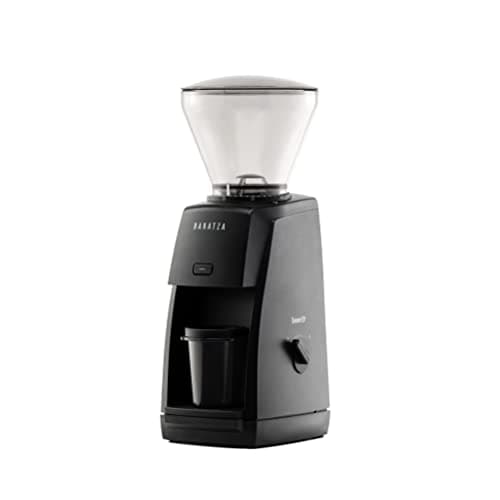
Baratza Encore ESPTop pickAn Encore reworked for espresso: the first 20 clicks are a fine, high-resolution espresso range, and the remaining 20 cover filter.
We have not handled these units. Everything above comes from published manufacturer documentation, cited inline, plus arithmetic you can redo yourself. Everyone in this category says they tested twenty machines; we have not tested any, and we say so. Here is what we do instead.
01
Baratza Encore ESP
The default first electric grinder
An Encore reworked for espresso: the first 20 clicks are a fine, high-resolution espresso range, and the remaining 20 cover filter.
Published specifications for the Baratza Encore ESP, with sources
Burr
40 mm M2 conical, quick-release for cleaning [source]
Grind range
#1-20 optimized for espresso in fine steps; #21-40 for filter [source]
Burr speed
550 RPM, reduced to limit heat, noise and static [source]
Twenty fine clicks inside the espresso range is the specification that matters. Grinders that give you five usable espresso settings cannot be dialed in; this one can.
550 RPM is deliberately slow. Slower burrs mean less heat and less static, which in practice means less ground coffee stuck to the inside of the chute and thrown around your counter.
It ships with both 54 mm and 58 mm dosing, which covers a Breville and a Gaggia without buying anything else.
What it does well
Genuine fine adjustment across the espresso range
Covers filter grinding too, so it is not a single-purpose purchase
Quick-release burr makes cleaning a two-minute job
Fits both common portafilter sizes out of the box
What you give up
Retains some grounds between doses, like most hoppered grinders
Louder than a hand grinder, obviously
Skip it if you already have a capable hand grinder and only make one or two drinks a day — you would be buying convenience, not better coffee.
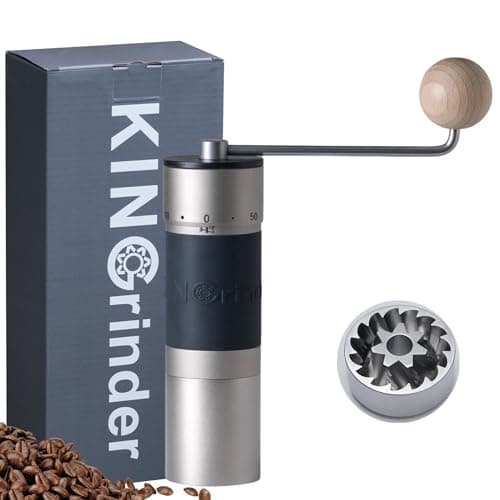
An external-adjustment hand grinder aimed squarely at espresso, from the value end of the market.
We have not compiled a cited spec sheet for this pick yet, so there is no spec table here. What follows is about fit — who it is for and who it is not — not about numbers we cannot source. See how we pick.
External adjustment means you change the grind without taking the grinder apart or losing your setting, which is the difference between dialing in and guessing.
This category exists because espresso needs adjustment steps small enough that a five-position dial is useless.
What it does well
External adjustment you can count and return to
Espresso-focused rather than filter-first
What you give up
Manual effort
Less established support than the bigger names
Skip it if you want the shortest path to a working setup with no research — a well-known electric grinder is the lower-effort answer.
A single-dose electric grinder with flat burrs — a category that used to start at three times the price.
We have not compiled a cited spec sheet for this pick yet, so there is no spec table here. What follows is about fit — who it is for and who it is not — not about numbers we cannot source. See how we pick.
Single dosing means you weigh exactly the beans for one shot and grind them all, instead of keeping a hopper full. Less stale coffee sitting in the machine, less retained grounds between shots.
Flat burrs and conical burrs both make good espresso. The practical difference at home is retention and workflow, not a quality ranking.
What it does well
Single-dose workflow without a hopper full of stale beans
Stepless-style fine adjustment in the espresso range
What you give up
You must weigh beans before every grind — that is the workflow, not a flaw
More grinder than a first setup strictly needs
Skip it if this is your first grinder and your machine is an entry-level one. The grinder would be the most capable part of the setup by a wide margin.
Stepped, without much argument. When you are learning, being able to write "click 8, 18 g in, 36 g out, 27 seconds" and come back to it is worth far more than the ability to sit between click 8 and click 9. Stepless adjustment becomes valuable once you have a repeatable process and you are chasing a specific result — which is not month one.
The number to actually check is not stepped versus stepless, it is **how many usable steps sit inside the espresso range**. A grinder with 40 clicks spread across espresso and French press has far fewer espresso positions than the total suggests.
Questions people actually ask
Is stepless adjustment better for espresso?+−
It offers finer control, but it is harder to learn on because you cannot return to a setting reliably. For a first setup, stepped adjustment with plenty of clicks in the espresso range is the better tool.
How many grind settings do I need?+−
It is not the total that matters, it is how many sit inside the espresso range. Baratza states 20 fine clicks there on the Encore ESP; a grinder with 16 settings spread across every brew method has far fewer.
Can I convert a stepped grinder to stepless?+−
Some models can be modified, and doing so voids the warranty and removes your ability to return to a setting. It is not something a first setup needs.
What do I do if one click is too big a jump?+−
Adjust the dose instead. A gram more coffee slows the shot; a gram less speeds it up. That is a standard tool, not a compromise.