Heads up: we earn a commission if you buy through the links on this page, at no extra cost to you. It never changes the order of the list. Full disclosure · how we pick.
If you are shopping for a Philips espresso machine, the first thing to know is that Philips's current US lineup has no espresso machine in the sense most guides mean — no model where you grind, dose, tamp and pull the shot yourself. What Philips sells in the US is two different kinds of automatic machine, and choosing between them matters more than choosing between models.
This page covers the lineup Philips itself currently lists in its US store, compared on the specifications Philips publishes for each model and cited at the bottom. That last part turns out to be more interesting than usual, because Philips publishes one figure that explains more than any preset count, and contradicts itself on others.
Philips makes two kinds of machine
Philips's two families, and who each one is for
LatteGo (2300, 3300, 5500)
Baristina and Baristina Latte
What it is
A bean-to-cup automatic: beans in the top, a finished drink out of the spout
A compact machine with a handle you swipe; it grinds, tamps and brews into it
What you do
Choose a drink and press a button
Swipe the handle, then (on the Latte) texture milk with a wand that measures it
Milk
LatteGo carafe, froths automatically into the cup
None on the Baristina; a measuring Smart Wand on the Latte
Grind adjustment
12 settings, published for all three
Not adjustable on the Baristina, per Philips; none published for the Latte
Feels like
A coffee appliance
An espresso machine with the hard parts removed
Neither family teaches you to make espresso, and that is not a criticism — it is the point of both. If you want to learn the skill, Philips is the wrong brand and manual vs automatic espresso machines explains the alternative. If you want good coffee with the skill removed, read on.
Decide these four things before you look at models
**Do you drink milk drinks?** If you drink espresso or black coffee only, the simplest route is the original Baristina, and every LatteGo model is carrying a milk system you will not use.
**Which drinks, exactly?** The LatteGo models share a grinder and a milk system and differ mainly in presets. Write down the three drinks you actually make, then check whether the entry model makes them. Most people stop there.
**Will you change beans?** A fixed grind works for one bean and struggles when the next bag needs a finer or coarser setting. If you like trying different coffees, rule the original Baristina out now.
**Where will it go?** Philips states the Baristina is 7.08 inches wide, the 2300 is 9 inches wide and the Baristina Latte is 10.1 inches wide. For kitchens where that difference decides it, compact espresso machines goes through footprint properly.
Quick picks — Which Philips espresso machine for a beginner
#
Pick
Best for
Type
Price
1
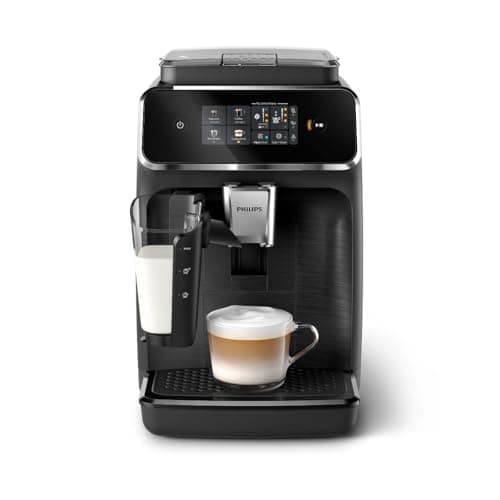
Philips 2300 Series LatteGo (EP2330/10)Top pickThe entry point to Philips's current LatteGo range: the same 12-setting ceramic grinder and two-part milk system as the pricier models, with four presets instead of six or twenty.
A first bean-to-cup machine that also makes milk drinks
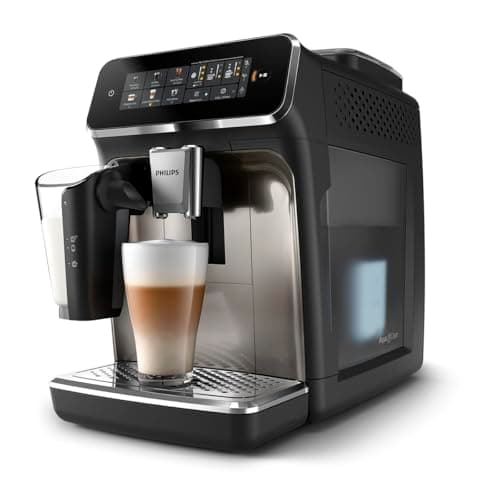
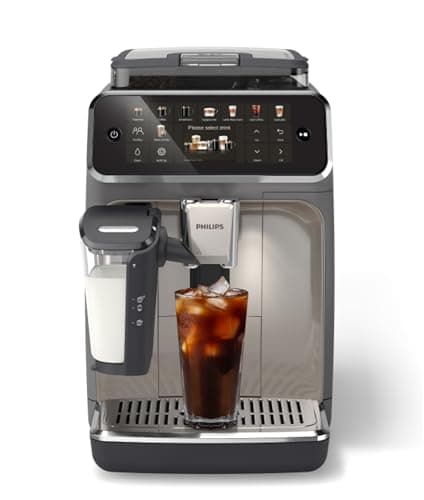
Philips 3300 Series LatteGo (EP3347/90)The 2300 plus the two presets people most often miss — cappuccino and iced coffee — and SilentBrew, on the same grinder and milk system.
Philips 5500 Series LatteGo (EP5544/94)Twenty presets and a fast start on the same grinder, milk system and body as the 3300. You are paying for range, not for a different cup.
A household where everyone drinks something different
Philips Baristina Latte (BAR400/60)A portafilter-style handle that grinds, tamps and brews on its own, plus a milk wand that measures the milk for you. Philips publishes less about it than about the LatteGo range.
Lattes from a machine that still handles like an espresso machine
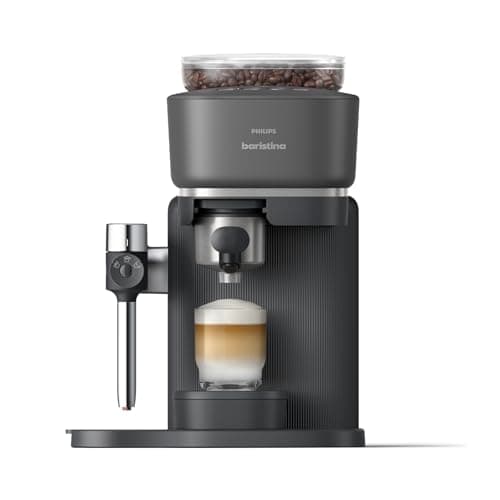
Philips BaristinaThe smallest and simplest Philips: swipe the handle and it grinds, tamps and brews. Philips states the grind is not adjustable, and that is the whole trade.
We have not handled these units. Everything above comes from published manufacturer documentation, cited inline, plus arithmetic you can redo yourself. Everyone in this category says they tested twenty machines; we have not tested any, and we say so. Here is what we do instead.
01
Philips 2300 Series LatteGo (EP2330/10)
A first bean-to-cup machine that also makes milk drinks
The entry point to Philips's current LatteGo range: the same 12-setting ceramic grinder and two-part milk system as the pricier models, with four presets instead of six or twenty.
Published specifications for the Philips 2300 Series LatteGo (EP2330/10), with sources
The grinder and the milk system are the two parts that decide daily life with an automatic machine, and Philips specifies both identically on the 2300, the 3300 and the 5500. Moving down to the 2300 costs you presets, not hardware.
The four presets Philips lists are espresso, black coffee, latte macchiato and hot water. Philips's EP2330/14 page elsewhere calls them "hot and iced drinks", so if iced coffee is the reason you are buying, confirm it first — the 3300 lists iced coffee unambiguously.
Philips sells this series under two US part numbers, EP2330/10 and EP2330/14, and publishes the same four drinks and the same LatteGo system for both. The /10 is the one stocked new, so it is what the buy link above goes to. Its page is the thinner of the two, so the grinder, filter, dose and dimension figures here are from the EP2330/14 page — each row says which page it came from.
What it does well
Same 12-setting ceramic grinder as the pricier LatteGo models
Two-part milk system Philips states cleans in under 10 seconds
AquaClean filter stated to remove the need to descale for up to 5,000 cups
What you give up
No cappuccino preset among the four Philips lists
Philips's page is inconsistent about whether it makes iced drinks
Philips does not publish water tank or bean hopper capacity
Skip it if you want to learn to pull shots. Nothing about this machine asks you to, and nothing about it lets you.
Philips publishes the dose behind the strength setting, and it tells you the button physically changes the amount of coffee rather than being a label.
SilentBrew's 40% is measured against Philips's own earlier machines, not against other brands. Read it as quieter than the model it replaced, not as quiet.
What it does well
Cappuccino and iced coffee listed as presets
SilentBrew, stated 40% quieter than Philips's previous models
Same two-part LatteGo milk system and 12-setting grinder
What you give up
Strength tops out at a stated 9 g of coffee per drink
Philips does not publish water tank or bean hopper capacity
You do not control dose or yield beyond three strength steps
Skip it if you only drink espresso and black coffee — the 2300 makes both with the same grinder, and the extra presets are what you would be paying for.
Philips publishes the same grinder, the same milk system, the same dimensions and the same weight for the 5500 as for the 3300. The published differences are the preset count and QuickStart.
Philips's own page mentions user profiles four times and gives three different counts: 2, 5, and 4 plus a guest. We have not picked one. If profiles are the reason you are buying, confirm the count with Philips first.
Fifteen bar is the pump's maximum, not the pressure at the coffee — the same caveat that applies to every machine advertising a bar figure.
What it does well
20 hot and iced presets
Stated 3-second QuickStart
Same grinder and milk hardware as the 3300, so nothing is traded away
What you give up
Grinder, milk system and body match the 3300, so the extra money buys presets and speed
Philips's own page is inconsistent about user profiles
Skip it if one or two people drink the same few drinks. The 3300 covers that with identical grinder and milk hardware.
Lattes from a machine that still handles like an espresso machine
A portafilter-style handle that grinds, tamps and brews on its own, plus a milk wand that measures the milk for you. Philips publishes less about it than about the LatteGo range.
Published specifications for the Philips Baristina Latte (BAR400/60), with sources
Grinds, tamps and brews espresso in under 60 seconds [source]
Milk
Smart Wand that measures the milk directly to create microfoam automatically [source]
Milk types
Designed for dairy and plant-based milks, including oat and almond [source]
Dimensions
14.5 D × 13.5 H × 10.1 W in, as published [source]
It sits between Philips's two families. You handle a portafilter the way you would on an espresso machine, but the grinding and tamping are automatic, as on a bean-to-cup.
A wand that measures the milk takes away the guesswork of when to stop steaming.
Philips publishes no grind adjustment for this model. It says plainly that the original Baristina's grind is not adjustable, so do not assume this one differs until Philips says it does.
What it does well
Milk wand that measures the milk rather than leaving it to you
Philips states it works with dairy and plant-based milks
Espresso-machine handling with no tamping technique to learn
What you give up
No grind adjustment published
Widest Philips on this page, at a stated 10.1 inches
No pump pressure, tank or hopper figures published
Skip it if you want to learn espresso properly. The handle looks like a portafilter, but grinding and tamping — the two real skills — are done for you.
The smallest and simplest Philips: swipe the handle and it grinds, tamps and brews. Philips states the grind is not adjustable, and that is the whole trade.
Published specifications for the Philips Baristina, with sources
Workflow
Swipe the handle; it grinds, tamps into the portafilter and brews [source]
None built in; Philips sells a separate Baristina frother [source]
Philips presents the fixed grind as a convenience. For a machine that makes espresso it is also a ceiling: grind size is the main thing you change when a shot runs too fast or too slow, and here you cannot change it.
At a stated 7.08 inches wide it is the narrowest Philips on this page by a clear margin.
Philips publishes specifications for the BAR305, and every Baristina on Amazon carries a different variant code. Rather than guess that they are the same machine, the link below searches Amazon for the Baristina instead of pointing at one listing.
What it does well
Narrowest Philips here, at a stated 7.08 inches
Nothing to adjust and nothing to learn
No milk system means no milk system to clean
What you give up
Grind size is not adjustable, per Philips
A latte needs a second appliance
We could not pin it to one exact Amazon listing
Skip it if you change beans often or want your shots to improve. A fixed grind cannot follow a bean that needs to be ground finer or coarser.
The three LatteGo machines are closer to each other than their price gaps suggest. Here is what Philips publishes for each, side by side.
2300, 3300 and 5500 compared, from Philips's US product pages
2300 (EP2330/14)
3300 (EP3347/90)
5500 (EP5544/94)
Presets
4
6
20
Iced coffee
Not in the 4 listed presets
Yes
Yes
Cappuccino preset
Not in the 4 listed presets
Yes
Yes
Grinder
Ceramic, 12 settings
Ceramic, 12 settings
Ceramic, 12 settings
Milk system
LatteGo, two parts
LatteGo, two parts
LatteGo, two parts
Water filter
AquaClean, up to 5,000 cups
AquaClean, up to 5,000 cups
AquaClean, up to 5,000 cups
Dose, lowest to highest strength
6 g to 9 g
6 g to 9 g
6 g to 9 g
Noise
No claim published
SilentBrew, 40% quieter than previous models
SilentBrew, 40% quieter than earlier models
Quick start
No claim published
No claim published
Ready in 3 seconds
Dimensions
14 H × 17 D × 9 W in
9.6 × 14.6 × 17.0 in
9.6 × 14.6 × 17.0 in
Read down the grinder, dose, milk and filter rows and they are identical. That is the useful finding: **the parts that decide what the coffee tastes like and how much cleaning you do are the same on all three.** Moving up the range buys presets, iced drinks, quieter brewing and a faster start. None of those are trivial, but none of them change the cup.
One caution on the dimensions row. Philips labels the 2300's figures by height, depth and width, and gives the 3300 and 5500 as three unlabeled numbers. So we cannot tell you from Philips's pages alone whether the 2300 is really deeper than the other two or whether the figures are simply in a different order. Measure against the machine in a store, or buy from a retailer with a free return window.
The number that explains the strength button
On the product page for each of the three LatteGo machines, Philips states that the brew unit uses between 6 g and 9 g of ground coffee, from the lowest strength setting to the highest. That is the figure that explains what the strength button physically does: it changes how much coffee goes in.
It also sets expectations. For comparison, Breville states an 18 g dose for the double basket on its Bambino, a conventional espresso machine. On those two published figures, the strongest setting on a LatteGo machine uses half the coffee of one Bambino double. That is not a defect — an automatic is designed around a different drink — but it is why people moving from café espresso sometimes find a bean-to-cup's strongest setting lighter than they expected. If strength is your priority, a darker roast will do more than any setting; see light vs dark roast.
The Baristina, and the setting it does not have
The original Baristina is the most interesting machine Philips sells and the easiest to misjudge. You swipe a portafilter-style handle and it grinds, tamps and brews at what Philips states is 16 bar. It is a stated 7.08 inches wide. It looks and feels much more like an espresso machine than a LatteGo does.
And Philips states, in so many words, that its grind size is not adjustable. Philips frames that as a convenience, and for one person using one bean it genuinely is. But grind is the main adjustment in espresso — it is what you change when a shot runs through too fast and tastes sour, or too slowly and tastes bitter. Dialing in explains the process a fixed grind removes. Without that control, the machine cannot follow a bag of beans that wants to be ground differently from the last one.
The Baristina Latte adds a milk wand that measures the milk for you and, per Philips, works with dairy and plant-based milks including oat and almond. It is the closest thing Philips makes to a beginner espresso machine with milk. Philips publishes no grind adjustment for it, though — so until it does, assume the same limitation as its sibling.
A note on the original Baristina's buy link. Philips publishes its specifications for model BAR305, and every Baristina currently on Amazon carries a different variant code. They are very likely the same machine in other colors, but we match listings on the model number, not on a likelihood — so that link searches Amazon for the Baristina rather than pointing you at one listing we cannot vouch for.
The older Philips models you will still find for sale
Search for a Philips espresso machine and the 2200 and 3200 still appear, offered by third-party sellers. Philips's own US store no longer lists either of them; the 2300 and 3300 fill those slots. We have not picked them for that reason. Our ordering criteria give weight to availability and parts, because an automatic machine has a brew unit, seals and a milk carafe that may one day need replacing, and a model its maker has stopped listing is the one where that gets harder first.
At the other end, Philips also sells the Café Aromis 8000, with a LatteGo Pro milk system, above the 5500. For a first machine, the table above makes the case against it: the grinder and milk hardware that decide the cup are already on the 2300.
What a Philips will not do for you
**Replace a grinder you choose.** The grinder is built in and you cannot upgrade it separately — the same trade covered on machines with a built-in grinder.
**Remove cleaning.** AquaClean addresses scale, and LatteGo makes the milk system quick to rinse. Neither makes the machine self-cleaning; descaling covers what the filter does and does not replace.
**Make the pressure figure mean much.** The 5500's 15 bar and the Baristina's 16 bar are pump maximums, not the pressure at the coffee. What is espresso explains why that number is advertised and why it does not rank machines.
**Cost less to run than a manual machine.** You still buy beans; a bean-to-cup simply uses them for you. The arithmetic is on what home espresso costs to run.
Philips or another brand?
If you want an automatic machine, Philips is a strong default mainly because of the milk system: a two-part carafe that rinses under the tap is the version people keep up with. But it is not the only option, and our bean-to-cup roundup weighs Philips against De'Longhi and Ninja on the same terms. If what you actually want is to make espresso yourself, look at the beginner Brevilles or the beginner De'Longhis instead — they are different products, not better or worse ones.
How we ranked these
In order: does it make the drinks a beginner asks for without failing them in the first month, is the specification published, and is it in the maker's current lineup. The 2300 leads because it has the full grinder and milk hardware of the range with nothing a first buyer needs missing. The original Baristina ranks last not because it is poor, but because a fixed grind is the limitation most likely to disappoint someone who gets into coffee. The full method is on how we pick.
We have not used any of these machines. Every specification on this page comes from Philips's own US product pages, linked below, and every price is pulled live from the specific listing we link to.
Questions people actually ask
Which Philips espresso machine is best for a beginner?+−
For most beginners, the 2300 Series LatteGo. Philips specifies the same 12-setting ceramic grinder, two-part LatteGo milk system and AquaClean filter on it as on the 3300 and 5500; the pricier models add presets such as cappuccino and iced coffee rather than different hardware.
What is the difference between the Philips 2300, 3300 and 5500?+−
Mainly presets. Philips lists 4 on the 2300 (espresso, black coffee, latte macchiato and hot water), 6 on the 3300, adding cappuccino and iced coffee, and 20 on the 5500. All three share a 12-setting ceramic grinder, the same stated 6 g to 9 g dose range and the LatteGo milk system. The 3300 and 5500 add SilentBrew, and the 5500 adds a stated 3-second QuickStart.
Is the Philips Baristina a real espresso machine?+−
It grinds, tamps and brews into a portafilter-style handle at a stated 16 bar, so it makes espresso. But Philips states the grind size is not adjustable, which removes the main control used to dial in a shot. It suits one person using one bean, not someone who wants to experiment.
Is the Philips 3200 LatteGo discontinued?+−
Philips's US store no longer lists it; the 3300 occupies that position in the current lineup. Third-party sellers still offer the 3200. We do not have a statement from Philips on discontinuation, so treat it as no longer current rather than as officially discontinued.
Do Philips espresso machines need descaling?+−
Philips states the AquaClean filter lets the LatteGo machines go up to 5,000 cups without descaling, provided you change the filter when the machine prompts you. That replaces descaling, not cleaning — see descaling.
Which Philips makes the strongest coffee?+−
On strength settings alone, none of the LatteGo machines is stronger than another: Philips states the same 6 g to 9 g dose range, lowest to highest setting, for the 2300, 3300 and 5500. For comparison, Breville states 18 g for the Bambino's double basket. If strength matters most, bean choice and roast will do more than any setting.