Heads up: we earn a commission if you buy through the links on this page, at no extra cost to you. It never changes the order of the list. Full disclosure · how we pick.
Both machines grind and brew in one footprint, which is the reason most people are looking at either. They differ on how much of the process they take over, and on one specification that is more useful than it sounds.
Quick picks — Ninja vs Breville: which all-in-one
#
Pick
Best for
Type
Price
1
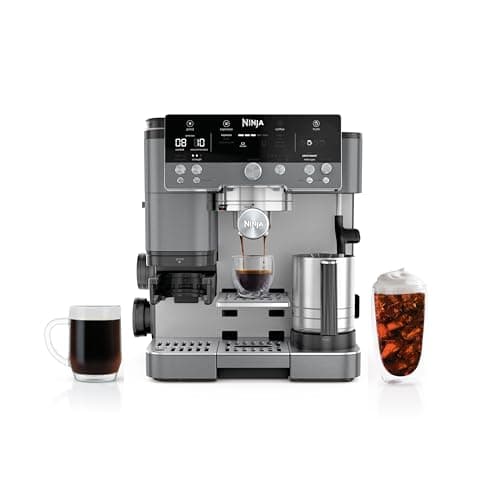
Ninja Luxe Café Premier (ES601)Top pickA three-in-one with a built-in conical burr grinder, a built-in scale and guided grind-size prompts — unusually beginner-shaped for the price.
A household that wants espresso, drip and cold brew from one machine
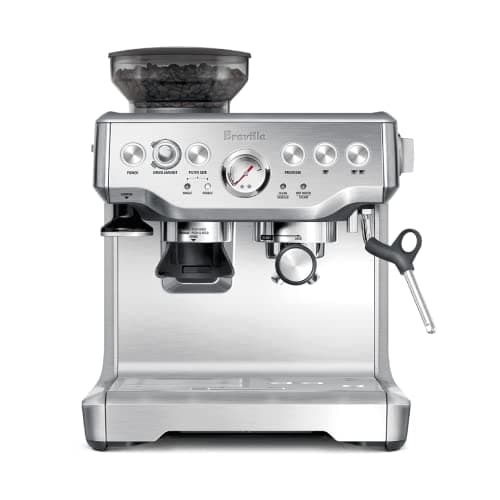
Breville Barista Express (BES870)The default all-in-one: a conical burr grinder with 16 settings built into a machine with a 54 mm basket and PID-controlled temperature.
One box, one counter footprint, machine and grinder together
We have not handled these units. Everything above comes from published manufacturer documentation, cited inline, plus arithmetic you can redo yourself. Everyone in this category says they tested twenty machines; we have not tested any, and we say so. Here is what we do instead.
01
Ninja Luxe Café Premier (ES601)
A household that wants espresso, drip and cold brew from one machine
A three-in-one with a built-in conical burr grinder, a built-in scale and guided grind-size prompts — unusually beginner-shaped for the price.
Published specifications for the Ninja Luxe Café Premier (ES601), with sources
Grinder
Conical burr with 25 grind settings, covering espresso through drip [source]
Dosing
Built-in scale, dosing by weight per drink [source]
Modes
Espresso, drip coffee and rapid cold brew, with guided grind-size recommendations [source]
A built-in scale is rare at this price and it matters more than it sounds: weighing the dose is the single change that makes shots repeatable, and a machine that does it removes the most-skipped step.
Twenty-five grind settings is more resolution than the Barista Express offers, which is a genuine point in its favor.
The three-in-one framing is the risk. Machines that do three jobs are harder to service and harder to replace one part of.
What it does well
Built-in scale, so the dose is weighed without you owning a scale
25 grind settings — real resolution for the money
Covers drip and cold brew for the rest of the household
What you give up
More to go wrong than a single-purpose machine
The guided prompts are a floor, not a ceiling — control is limited
Skip it if espresso is the only thing you want. A dedicated machine plus a real grinder gives you more headroom for the same money.
Sixteen grind settings is the number to weigh. It is enough to find an espresso grind, and it is not enough to make small corrections once you are close — which is exactly the trade-off you accept for the convenience of one box.
PID temperature control at a stated 200°F is a genuine feature and not a marketing word: it means the water temperature is held rather than allowed to drift between shots.
The footprint argument is the strongest one here. A separate machine and grinder need roughly twice the counter, and on a small kitchen counter that decides it.
What it does well
Machine and grinder in one footprint, which is often the real constraint
Grinds straight into the portafilter — no transfer, no mess step
PID-held brew temperature
Manual wand, so milk skill is learnable on it
What you give up
Sixteen settings is coarse resolution once you are dialing in
The grinder cannot be upgraded independently of the machine
Bigger and heavier than a standalone machine
Skip it if you already own a decent burr grinder — you would be paying twice for the same job, and a separate machine plus your existing grinder will beat it.
Ninja Luxe Café Premier and Breville Barista Express, as each maker states them
Ninja Luxe Café Premier
Breville Barista Express
Grinder
Conical burr, 25 grind settings
Integrated conical burr, 16 grind settings
Dosing
Built-in scale, dosed by weight per drink
Dose control, ground to the portafilter
Guidance
Automatic grind-size recommendations and brew monitoring
None — you decide
Portafilter
Not stated on the product page
54 mm stainless steel, 18 g dose
Temperature
Not stated on the product page
Thermocoil with PID control at 200°F
Other modes
Drip coffee and rapid cold brew
Espresso only
Two rows there decide most of it. Twenty-five grind settings against sixteen is a real advantage for the Ninja, because espresso adjustment is about small corrections and more steps means smaller ones. And a built-in scale is genuinely unusual at this price: weighing the dose is the single change that makes shots repeatable, and it is the step people skip most. If Ninja is the brand you have settled on, the whole Ninja lineup is compared here.
Breville's counter is temperature. It states PID control holding 200°F, which means the brew water is held rather than allowed to drift, and it publishes the basket size and dose so that every recipe written for a 54 mm, 18 g setup applies to it directly. Ninja does not state either on its product page.
The philosophical difference
The Ninja is designed to tell you what to do. Its Barista Assist feature recommends a grind size and monitors the brew. The Barista Express is designed to do exactly what you tell it, including when you are wrong. Which of those you want is a real preference and not a quality question.
The Ninja also does drip coffee and cold brew. That is a genuine advantage in a household where not everyone drinks espresso, and a genuine risk in that a machine doing three jobs has more to go wrong and is harder to replace one part of.
Questions people actually ask
Does the Ninja Luxe Café have a built-in scale?+−
Ninja states it does, and that the machine doses by weight per drink. That is unusual at this price and it removes the most commonly skipped step in making a repeatable shot.
Which has more grind settings?+−
The Ninja. Ninja states 25 grind settings covering espresso through drip; Breville states 16 on the Barista Express. More steps means smaller corrections when you are dialing in.
Does the Barista Express have PID temperature control?+−
Breville states Thermocoil heating with PID temperature control delivering water at 200°F. It does not appear on Ninja's stated specification for the Luxe Café Premier.
Can either machine make drip coffee?+−
The Ninja can — it states espresso, drip and rapid cold brew. The Barista Express is an espresso machine only.