Heads up: we earn a commission if you buy through the links on this page, at no extra cost to you. It never changes the order of the list. Full disclosure · how we pick.
Most first-machine advice starts with a list. This starts with the questions, because the list only makes sense once you know which of these five you care about. Work through them in order — each one eliminates more of the market than the one after it.
1. What drink do you actually want?
Be honest. If the answer is a latte every morning, the milk system is the most important part of the machine and you should be reading machines for milk drinks. If it is a straight double, milk features are money you will not use, and everything about the machine's shot matters more.
2. How much counter do you have?
Measure the width, the depth and the height to the shelf above. Machines with top-loading water tanks need clearance to open. This one question often eliminates half the shortlist before you have compared a single feature, and it is why De'Longhi's stated 15 cm width on the Dedica sells so many of them.
3. Do you already own a grinder — and can it go fine enough?
If you own a blade grinder, the answer is no, and this is the most important sentence on the page. If you own a burr grinder made for drip coffee, the answer is probably also no. See burr versus blade for how to tell in thirty seconds. Whatever you conclude, the grinder budget comes out of the total before you pick a machine.
4. Do you want to learn, or do you want coffee?
Both are legitimate. Wanting coffee without the process points you at a bean-to-cup machine. Wanting to learn points you at a semi-automatic with a standard basket, where every variable is yours. Buying the wrong one of these is the most common regret in this category, and it has nothing to do with money.
5. How much total, machine and grinder together?
Total, not machine. Then split it roughly one-third to one-half toward the grinder. That single reallocation improves the coffee more than any feature you could buy with the same money on the machine side.
Quick picks — How to choose your first espresso machine
#
Pick
Best for
Type
Price
1
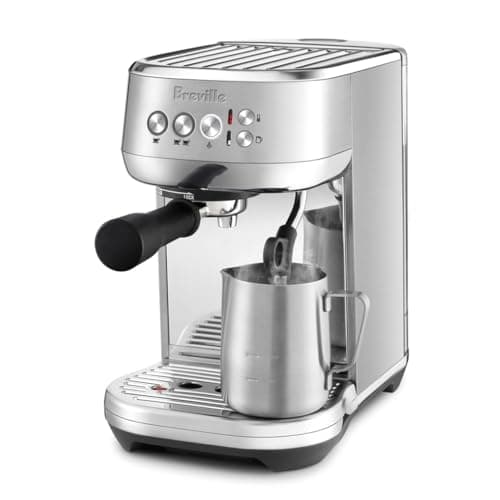
Breville Bambino Plus (BES500)Top pickThe standard answer to “which first machine” — full 54 mm portafilter and an 18 g dose, with the milk step automated so a flat white is possible on day one.
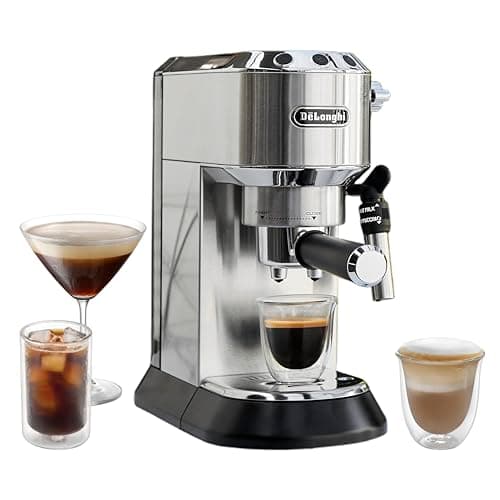
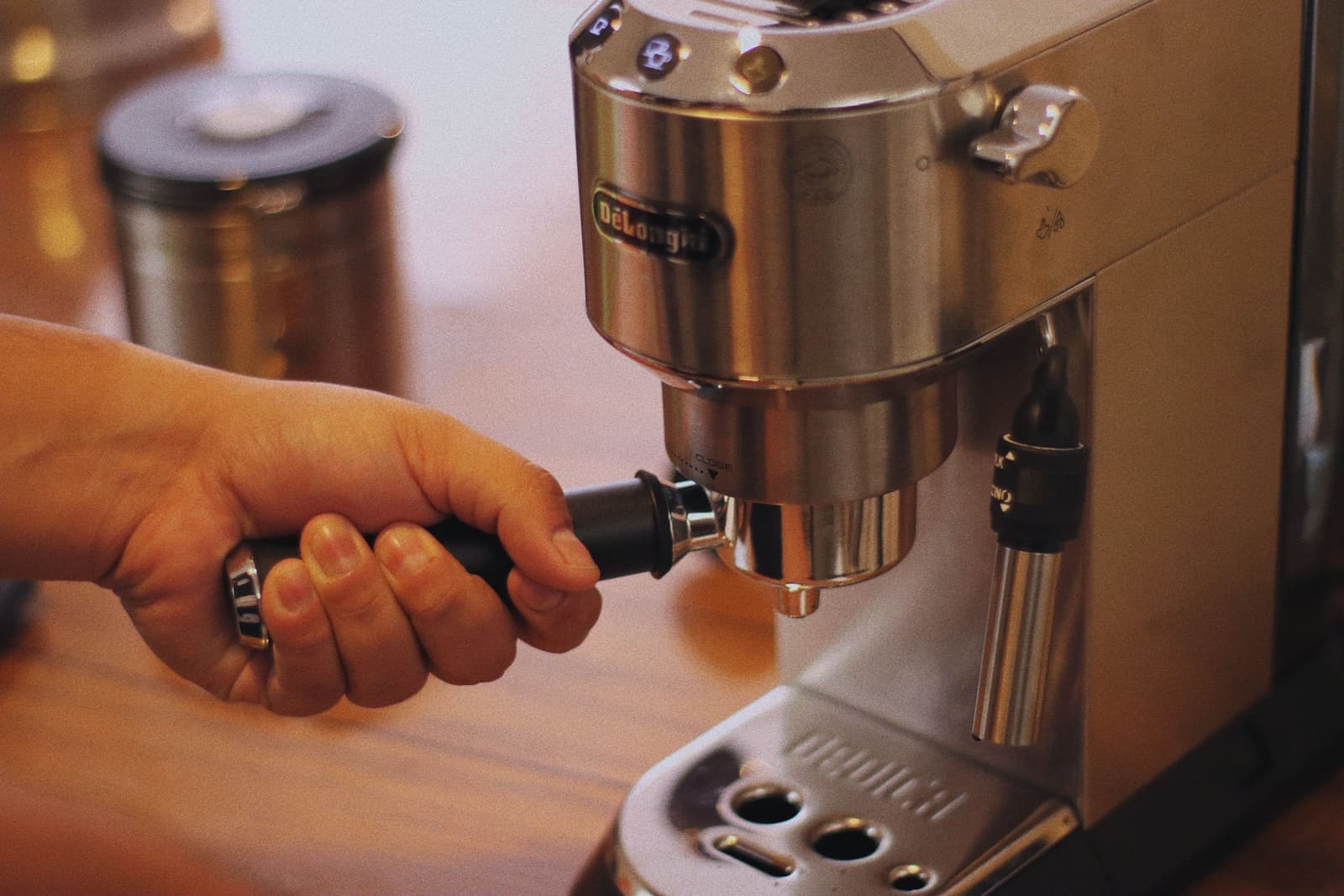
De'Longhi Dedica DeLuxe (EC685)The slim one. De'Longhi states a 15 cm width and calls it the slimmest pump coffee maker they make, which is the whole reason to choose it.
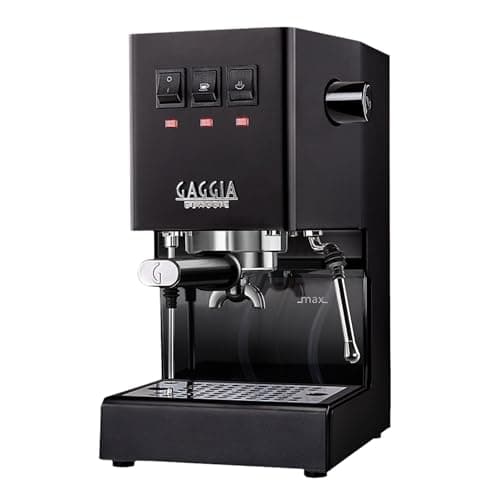
Gaggia Classic Evo ProThe long-running enthusiast entry point: a commercial-size 58 mm portafilter on a home machine, with a large aftermarket behind it.
We have not handled these units. Everything above comes from published manufacturer documentation, cited inline, plus arithmetic you can redo yourself. Everyone in this category says they tested twenty machines; we have not tested any, and we say so. Here is what we do instead.
01
Breville Bambino Plus (BES500)
A first machine you will not outgrow in a year
The standard answer to “which first machine” — full 54 mm portafilter and an 18 g dose, with the milk step automated so a flat white is possible on day one.
Published specifications for the Breville Bambino Plus (BES500), with sources
54 mm tamper, Razor dosing tool, 16 fl oz milk jug, single- and dual-wall baskets, cleaning tool and disc [source]
The 54 mm portafilter and 18 g dose matter more than they sound: they put the machine on the same dose a cafe uses, so any recipe you read applies to it directly and every 54 mm accessory fits.
The three-second heat-up is the difference between espresso being a weekday habit and a weekend project. A machine that takes fifteen minutes to be ready is a machine you use on Sundays.
The automatic steam wand is the single biggest reason this suits a first setup. Milk texturing is the skill that takes longest to learn; handing it to the machine removes the part most likely to make you give up.
What it does well
Standard 54 mm basket, so recipes and accessories from anywhere fit
Ready in seconds, which is what makes it a habit rather than a project
Automatic milk means a drinkable cappuccino before you can texture by hand
The manual wand is still there when you want to learn
What you give up
No grinder — budget for one separately, and that is the right trade
Small water tank compared with a bean-to-cup machine; refills are frequent
Nothing here helps if your grinder cannot go fine enough
Skip it if you want one box that does everything with no learning curve — a bean-to-cup machine is the honest answer for that, and it is a different product.
Takes ground coffee (1 or 2 cups) and E.S.E. pods [source]
Milk
Adjustable frothing wand / cappuccino system [source]
Fifteen centimeters of width is genuinely unusual and it is why this machine keeps selling. If your counter run is already full, that number decides the purchase before any other spec does.
The E.S.E. pod compatibility is a fair hedge: it means the machine still makes a coffee on the day you have not restocked beans, without committing you to a pod ecosystem.
It uses a smaller basket than the 54 mm standard, so accessories and recipes written for 54 mm machines will not transfer directly.
What it does well
Fits where nothing else fits
Takes ground coffee or E.S.E. pods
Adjustable frothing wand rather than a fixed panarello
What you give up
Non-standard basket size limits accessory choice
Narrow body means a small water tank and frequent refills
Skip it if counter width is not actually your constraint — you are paying for the one thing it is best at and giving up basket standardization to get it.
The long-running enthusiast entry point: a commercial-size 58 mm portafilter on a home machine, with a large aftermarket behind it.
We have not compiled a cited spec sheet for this pick yet, so there is no spec table here. What follows is about fit — who it is for and who it is not — not about numbers we cannot source. See how we pick.
The 58 mm portafilter is the argument. It is the size commercial machines use, so every basket, tamper, distribution tool and bottomless portafilter on the market fits.
It asks more of you than a Breville does — there is no automatic milk, no PID from the factory, and the learning curve is real.
What it does well
58 mm commercial-standard portafilter with a huge accessory market
Simple, well-understood internals with parts availability
What you give up
Steeper learning curve than a machine designed for beginners
No automatic milk of any kind
Skip it if you want the machine to help you. This one does exactly what you tell it, including when you are wrong.
**Bar rating.** Pump maximum, not brew pressure. Espresso brews at around 9 bar.
**Number of drink buttons.** A latte button is a volume preset, not a different drink.
**Included accessories.** A plastic tamper and a plastic jug are not a reason to choose a machine.
**Whether it looks like a cafe machine.** Group-head styling on a small pump machine is styling.
**A review that says it was tested for six months.** Ask what was measured. Most of the time nothing was.
Questions people actually ask
What is the best first espresso machine?+−
There is no single answer, because the right machine depends on your counter, your drink and whether you already own a grinder. The most common good answer for a milk drinker with counter space is a compact semi-automatic with a 54 mm basket and an automatic wand, paired with an entry espresso grinder.
How much should I spend on my first espresso setup?+−
Enough for a grinder that reaches espresso fineness with fine adjustment, plus whatever the machine costs after that. That floor is lower than this category usually claims — we do the arithmetic on the cost page.
Should I buy used?+−
It can be good value on simple machines with parts availability, and risky on anything with electronics. Ask when it was last descaled — the answer tells you most of what you need to know about how it was treated.
How long does it take to make good espresso?+−
A couple of weeks of daily shots to get consistent, assuming the grinder is adequate. If it is not, no amount of time helps. See how long it takes to learn.