Heads up: we earn a commission if you buy through the links on this page, at no extra cost to you. It never changes the order of the list. Full disclosure · how we pick.
Most people buying a first espresso machine are not buying it for espresso. They are buying it for a latte, a flat white or a cappuccino — drinks that are mostly milk. That changes what matters: a machine that pulls a beautiful shot and cannot texture milk is the wrong machine for you. The machine we point at most often for exactly this buyer gets a page of its own in our Bambino Plus review.
There are three ways to get milk into your cup, in increasing order of how much you have to learn.
The three milk systems, and what each one can pour| System | What it does | What you can make |
|---|
| Automatic wand | Machine heats and textures to a set temperature and texture | Cappuccino, latte, flat white. Latte art is possible but not the goal. |
| Bean-to-cup milk system | Machine draws milk in and dispenses the finished drink | Every milk drink on the menu, at the machine's texture. |
| Manual wand | You control depth, angle and time | Anything, including latte art — after practice. |
Quick picks — Espresso machines for lattes and cappuccinos| # | Pick | Best for | Type | Price |
|---|
| 1 | 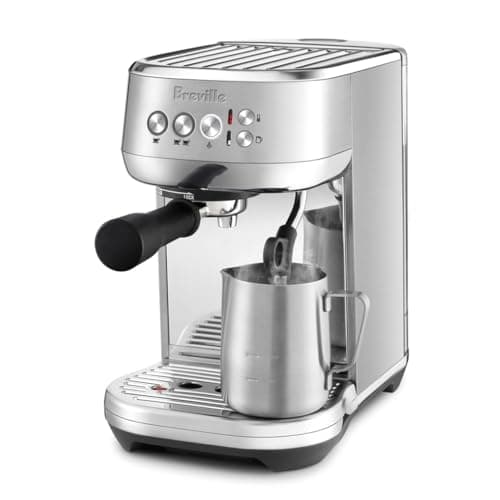 Breville Bambino Plus (BES500)Top pickThe standard answer to “which first machine” — full 54 mm portafilter and an 18 g dose, with the milk step automated so a flat white is possible on day one. | A first machine you will not outgrow in a year | Semi-automatic, auto milk | |
| 2 | 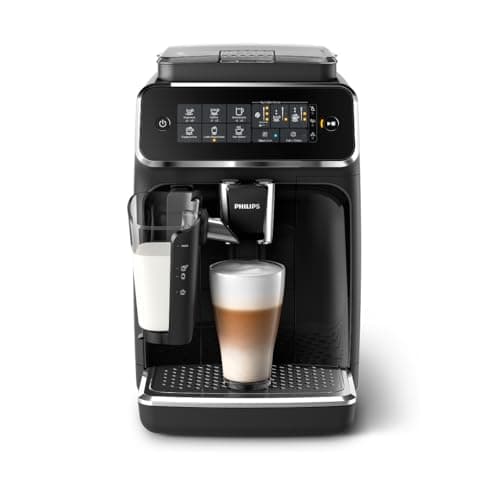 Philips Series 3200 LatteGoA bean-to-cup machine whose milk system is two parts with no tubes, which is the part of an automatic machine people usually come to hate. | Milk drinks with no technique and no cleaning ritual | Bean-to-cup automatic | |
| 3 | 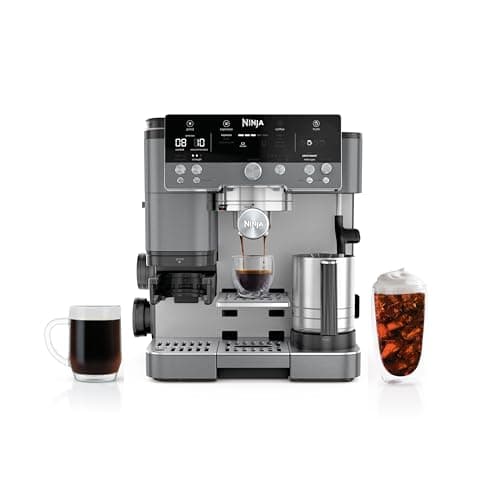 Ninja Luxe Café Premier (ES601)A three-in-one with a built-in conical burr grinder, a built-in scale and guided grind-size prompts — unusually beginner-shaped for the price. | A household that wants espresso, drip and cold brew from one machine | 3-in-1 with grinder + scale | |
| 4 | 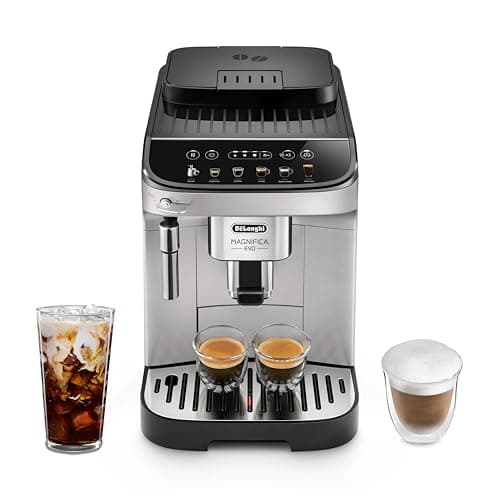 De'Longhi Magnifica EvoA bean-to-cup machine: beans in the top, drink in the cup, no portafilter and no technique. A different product from an espresso machine, and the right one for some people. | A household that wants coffee, not a hobby | Bean-to-cup automatic | |
We have not handled these units. Everything above comes from published manufacturer documentation, cited inline, plus arithmetic you can redo yourself. Everyone in this category says they tested twenty machines; we have not tested any, and we say so. Here is what we do instead.
01Breville Bambino Plus (BES500)
A first machine you will not outgrow in a year
The standard answer to “which first machine” — full 54 mm portafilter and an 18 g dose, with the milk step automated so a flat white is possible on day one.
Published specifications for the Breville Bambino Plus (BES500), with sources| Portafilter | 54 mm stainless steel [source] |
|---|
| Stated dose | 18 g [source] |
|---|
| Pump / extraction | 15 bar Italian pump, 9 bar extraction after low-pressure pre-infusion [source] |
|---|
| Heating | ThermoJet, stated to reach extraction temperature in 3 seconds [source] |
|---|
| Steam wand | Automatic and manual, 3 milk temperatures and 3 texture levels, 266°F steam [source] |
|---|
| Dimensions (W×D×H) | 11.9 × 7.4 × 14.3 in [source] |
|---|
| In the box | 54 mm tamper, Razor dosing tool, 16 fl oz milk jug, single- and dual-wall baskets, cleaning tool and disc [source] |
|---|
The 54 mm portafilter and 18 g dose matter more than they sound: they put the machine on the same dose a cafe uses, so any recipe you read applies to it directly and every 54 mm accessory fits.
The three-second heat-up is the difference between espresso being a weekday habit and a weekend project. A machine that takes fifteen minutes to be ready is a machine you use on Sundays.
The automatic steam wand is the single biggest reason this suits a first setup. Milk texturing is the skill that takes longest to learn; handing it to the machine removes the part most likely to make you give up.
What it does well
- Standard 54 mm basket, so recipes and accessories from anywhere fit
- Ready in seconds, which is what makes it a habit rather than a project
- Automatic milk means a drinkable cappuccino before you can texture by hand
- The manual wand is still there when you want to learn
What you give up
- No grinder — budget for one separately, and that is the right trade
- Small water tank compared with a bean-to-cup machine; refills are frequent
- Nothing here helps if your grinder cannot go fine enough
Skip it if you want one box that does everything with no learning curve — a bean-to-cup machine is the honest answer for that, and it is a different product.
02Philips Series 3200 LatteGo
Milk drinks with no technique and no cleaning ritual
A bean-to-cup machine whose milk system is two parts with no tubes, which is the part of an automatic machine people usually come to hate.
Published specifications for the Philips Series 3200 LatteGo, with sources| Grinder | 100% ceramic burrs, 12 grind settings, rated by Philips for at least 20,000 cups [source] |
|---|
| Strength settings | 3 aroma strength settings [source] |
|---|
| Brew temperature | Aroma Extract system holding water between 90 and 98°C [source] |
|---|
| Milk system | LatteGo, stated to clean under the tap in about 15 seconds [source] |
|---|
The 20,000-cup burr rating is a durability claim worth reading literally: at three drinks a day that is roughly eighteen years, so the burrs are not the thing that will fail first.
The milk system is the real differentiator. Automatic machines that pump milk through tubes need a cleaning cycle every day; a two-part carafe that rinses under the tap is the version people actually keep up with.
Twelve grind settings is plenty for a machine that also controls dose and yield itself, and would be tight on a machine where you control them.
What it does well
- Milk system that is genuinely quick to clean
- Ceramic burrs with a published durability figure
- No technique required from anyone in the house
What you give up
- You do not control dose or yield directly
- Larger footprint than a compact espresso machine
Skip it if you want to learn to pull shots. It is built to make that unnecessary, and it succeeds.
03Ninja Luxe Café Premier (ES601)
A household that wants espresso, drip and cold brew from one machine
A three-in-one with a built-in conical burr grinder, a built-in scale and guided grind-size prompts — unusually beginner-shaped for the price.
Published specifications for the Ninja Luxe Café Premier (ES601), with sources| Grinder | Conical burr with 25 grind settings, covering espresso through drip [source] |
|---|
| Dosing | Built-in scale, dosing by weight per drink [source] |
|---|
| Modes | Espresso, drip coffee and rapid cold brew, with guided grind-size recommendations [source] |
|---|
A built-in scale is rare at this price and it matters more than it sounds: weighing the dose is the single change that makes shots repeatable, and a machine that does it removes the most-skipped step.
Twenty-five grind settings is more resolution than the Barista Express offers, which is a genuine point in its favor.
The three-in-one framing is the risk. Machines that do three jobs are harder to service and harder to replace one part of.
What it does well
- Built-in scale, so the dose is weighed without you owning a scale
- 25 grind settings — real resolution for the money
- Covers drip and cold brew for the rest of the household
What you give up
- More to go wrong than a single-purpose machine
- The guided prompts are a floor, not a ceiling — control is limited
Skip it if espresso is the only thing you want. A dedicated machine plus a real grinder gives you more headroom for the same money.
04De'Longhi Magnifica Evo
A household that wants coffee, not a hobby
A bean-to-cup machine: beans in the top, drink in the cup, no portafilter and no technique. A different product from an espresso machine, and the right one for some people.
We have not compiled a cited spec sheet for this pick yet, so there is no spec table here. What follows is about fit — who it is for and who it is not — not about numbers we cannot source. See how we pick.
A bean-to-cup machine removes every variable you would otherwise learn to control, which is the point. Nobody in the house needs to be taught anything.
The trade is ceiling and repairability: you cannot adjust dose and yield the way you can on a machine with a portafilter, and there is more inside it to go wrong.
What it does well
- Anyone in the house can use it without instruction
- No separate grinder, no puck prep, no cleanup ritual
What you give up
- Very little control over the shot
- More internal complexity than a machine with a portafilter
Skip it if the appeal for you is making the coffee. This machine is specifically designed to take that part away.
What "microfoam" means and why it matters
Microfoam is milk with air folded into it so finely that the bubbles are invisible and the milk pours like wet paint. That is what makes a flat white a flat white instead of a coffee with foam on top. Breville states the Bambino Plus wand delivers 266°F steam with three milk temperatures and three texture levels, which is the machine doing the folding for you.
A panarello sleeve — the plastic collar on many cheap wands — injects air automatically and makes stiff, bubbly foam instead. It is fine on a cappuccino and it will not pour a flat white. If milk drinks are the point, this is the detail to check on any machine under $300.
If you want to learn to texture milk yourself
You need a bare wand, a properly shaped pitcher and about two weeks of practice. We wrote the method out step by step in how to steam milk, and the pitcher matters more than people expect — a straight-sided kitchen jug will not spin the milk. Start with milk pitchers.
Questions people actually ask
Which espresso machine is easiest for lattes?+−
One with an automatic steam wand or a bean-to-cup milk system, because both remove the texturing skill entirely. Breville frames the Bambino Plus as the model to choose over the plain Bambino for exactly this reason.
Can I make latte art on a beginner machine?+−
You can, on any machine with a bare manual wand and enough steam. What you cannot do is pour art with a panarello sleeve, because it makes stiff foam rather than microfoam. See milk for latte art.
Do I need a separate milk frother?+−
Only if your machine has no wand, or if you want cold foam — a steam wand adds heat by definition, so cold foam needs a whisk of some kind. See milk frothers.
What milk textures best?+−
Whole dairy milk is the most forgiving. Among plant milks, the barista editions are formulated to hold foam and the standard versions often will not. We cover the differences in which milk to use.