Heads up: we earn a commission if you buy through the links on this page, at no extra cost to you. It never changes the order of the list. Full disclosure · how we pick.
**If you want espresso — real crema, a shot you can dial in, and milk drinks — an AeroPress will not get you there, and AeroPress does not claim it will.** Its own product page says “espresso-style” and “rich like espresso”, never espresso, and it publishes no pressure figure at all, because the pressure is whatever your arm applies.
**If what you actually want is strong, low-bitterness coffee in two minutes with nothing to plug in and nothing to descale, buy the AeroPress and keep the other four hundred dollars.** It is the single best way to find out how much you care about this before committing to a machine.
The one question that settles it
**Do you want milk drinks?**
If the honest answer is yes — a flat white, a cappuccino, a latte on a Saturday — the AeroPress cannot serve you, because it has no steam wand and never will. You would be buying a press plus a separate frother, and at that point a machine with a wand is the simpler purchase. If the answer is no, and you drink your coffee black and strong, the case for spending hundreds of dollars gets considerably weaker.
What each one publishes
AeroPress Original against a first espresso machine | AeroPress Original | Breville Bambino / Bambino Plus |
|---|
| Pressure | Air pressure applied by hand — no figure published | 15 bar pump, 9 bar extraction after low-pressure pre-infusion |
| What it makes | Stated as “espresso-style”, cold brew and iced coffee | Espresso, to a stated 18 g dose in a 54 mm basket |
| Crema | Not claimed by AeroPress | Yes — the product of real brew pressure |
| Milk | None — no steam wand | Steam wand; automatic on the Plus |
| Time | Stated to brew and clean in under 2 minutes | Stated 3 seconds to temperature, plus grinding and puck prep |
| Yield | 10 oz, or up to three espresso-style shots | Shot by shot, as many as you want |
| Needs a grinder | Works with pre-ground; better with fresh | Effectively yes, and a capable one |
| Upkeep | Rinse it. Nothing to descale | Descaling, backflushing, wand care |
Quick picks — Espresso machine vs AeroPress| # | Pick | Best for | Type | Price |
|---|
| 1 | 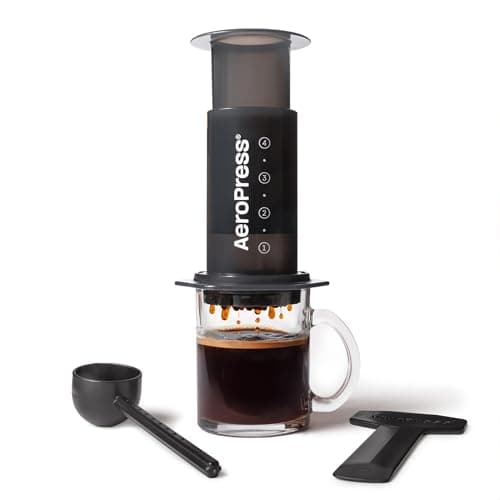 AeroPress Original Coffee PressTop pickNot an espresso machine and it does not claim to be one. What it is: the cheapest honest way to find out whether you actually like making coffee by hand before you spend hundreds on a machine. | Strong, espresso-style coffee for the price of two bags of beans | Manual press, no pump | |
| 2 | 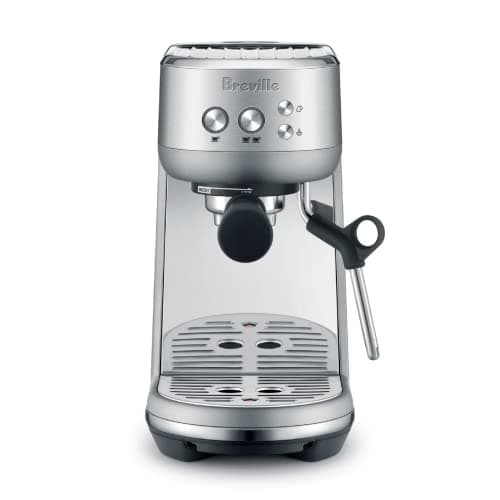 Breville Bambino (BES450)The Bambino Plus minus the automatic milk wand. Same 54 mm basket, same 18 g dose, same fast heat-up — you steam the milk. | The same shot for less, if you will texture milk yourself | Semi-automatic, manual milk | |
| 3 | 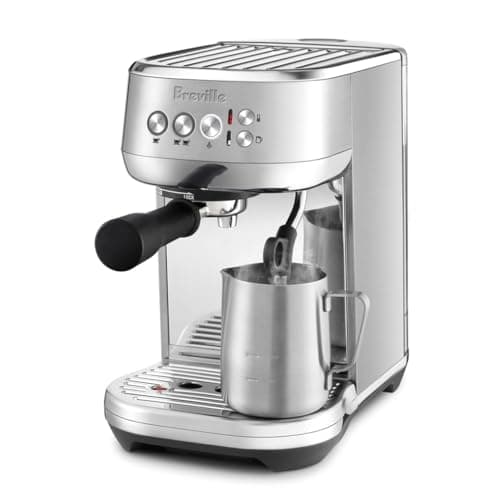 Breville Bambino Plus (BES500)The standard answer to “which first machine” — full 54 mm portafilter and an 18 g dose, with the milk step automated so a flat white is possible on day one. | A first machine you will not outgrow in a year | Semi-automatic, auto milk | |
| 4 | 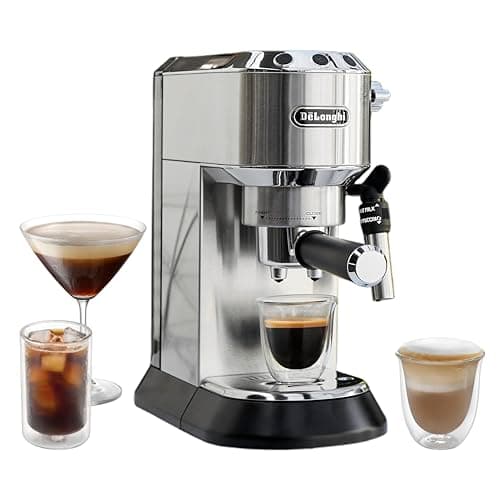 De'Longhi Dedica DeLuxe (EC685)The slim one. De'Longhi states a 15 cm width and calls it the slimmest pump coffee maker they make, which is the whole reason to choose it. | A narrow counter | Compact pump machine | |
We have not handled these units. Everything above comes from published manufacturer documentation, cited inline, plus arithmetic you can redo yourself. Everyone in this category says they tested twenty machines; we have not tested any, and we say so. Here is what we do instead.
01AeroPress Original Coffee Press
Strong, espresso-style coffee for the price of two bags of beans
Not an espresso machine and it does not claim to be one. What it is: the cheapest honest way to find out whether you actually like making coffee by hand before you spend hundreds on a machine.
Published specifications for the AeroPress Original Coffee Press, with sources| Capacity | 10 oz (1-2 cups); stated to make up to three espresso-style shots [source] |
|---|
| Brew time | Stated to brew and clean in less than 2 minutes [source] |
|---|
| Pressure | Air pressure, applied by hand — no figure published [source] |
|---|
| Brew styles | Stated as signature, espresso-style, cold brew and iced coffee [source] |
|---|
| Material | Polypropylene, stated BPA free [source] |
|---|
| Dimensions (H×W) | 5.25 × 4.2 in [source] |
|---|
| Weight | 7.75 oz for the full kit including scoop and stirrer [source] |
|---|
| In the box | Press, paper micro-filters, stirrer, scoop [source] |
|---|
| Warranty | 1 year [source] |
|---|
AeroPress describes the output as “espresso-style” and “rich like espresso” and never as espresso. That is the correct description: the device publishes no pressure figure because the pressure is whatever your arm applies, which is a long way below the roughly 9 bar that defines an espresso shot.
What you get instead is a concentrated, low-bitterness coffee from a device that heats nothing, descales never and costs less than most espresso accessories. For a lot of people asking whether to buy a machine, that is the honest first step.
What it does well
- Costs less than a tamper and a scale together
- Nothing to descale, nothing to plug in, no heat-up wait
- Forgiving of grind size in a way espresso is not
- Brews and rinses in under two minutes, by AeroPress's own figure
What you give up
- Not espresso — no pump pressure, and no real crema to speak of
- No steam wand, so milk drinks need a separate frother
- One press is one or two cups; it does not scale to a household
- Plastic body, which matters to some buyers
Skip it if what you specifically want is espresso with crema and a shot you can dial in. The AeroPress cannot do that and has never claimed to.
02Breville Bambino (BES450)
The same shot for less, if you will texture milk yourself
The Bambino Plus minus the automatic milk wand. Same 54 mm basket, same 18 g dose, same fast heat-up — you steam the milk.
Published specifications for the Breville Bambino (BES450), with sources| Dimensions (W×D×H) | 11.9 × 6.1 × 13.5 in [source] |
|---|
| Portafilter | 54 mm [source] |
|---|
| Stated dose | 18 g [source] |
|---|
| Pump / extraction | 15 bar Italian pump, 9 bar extraction after low-pressure pre-infusion [source] |
|---|
| Heating | ThermoJet [source] |
|---|
| Steam wand | Manual. Breville positions the Plus as the model to choose for an automatic wand [source] |
|---|
Breville's own page frames the difference in one line: choose the Plus if you want the automatic steam wand. Everything about the shot itself is the same.
If you drink espresso black, or mostly americanos, the automatic wand is a feature you would pay for and never use.
If you drink lattes every morning and have never steamed milk, this is the model that will frustrate you first.
What it does well
- The same 54 mm, 18 g, fast-heating shot as the Plus
- Cheaper, which frees money for the grinder — the better place to spend it
- Manual wand teaches you the skill rather than hiding it
What you give up
- Milk texturing is a real skill with a real learning period
- No grinder
Skip it if milk drinks are the whole reason you are buying a machine and you would rather not practice — the Plus exists exactly for that.
03Breville Bambino Plus (BES500)
A first machine you will not outgrow in a year
The standard answer to “which first machine” — full 54 mm portafilter and an 18 g dose, with the milk step automated so a flat white is possible on day one.
Published specifications for the Breville Bambino Plus (BES500), with sources| Portafilter | 54 mm stainless steel [source] |
|---|
| Stated dose | 18 g [source] |
|---|
| Pump / extraction | 15 bar Italian pump, 9 bar extraction after low-pressure pre-infusion [source] |
|---|
| Heating | ThermoJet, stated to reach extraction temperature in 3 seconds [source] |
|---|
| Steam wand | Automatic and manual, 3 milk temperatures and 3 texture levels, 266°F steam [source] |
|---|
| Dimensions (W×D×H) | 11.9 × 7.4 × 14.3 in [source] |
|---|
| In the box | 54 mm tamper, Razor dosing tool, 16 fl oz milk jug, single- and dual-wall baskets, cleaning tool and disc [source] |
|---|
The 54 mm portafilter and 18 g dose matter more than they sound: they put the machine on the same dose a cafe uses, so any recipe you read applies to it directly and every 54 mm accessory fits.
The three-second heat-up is the difference between espresso being a weekday habit and a weekend project. A machine that takes fifteen minutes to be ready is a machine you use on Sundays.
The automatic steam wand is the single biggest reason this suits a first setup. Milk texturing is the skill that takes longest to learn; handing it to the machine removes the part most likely to make you give up.
What it does well
- Standard 54 mm basket, so recipes and accessories from anywhere fit
- Ready in seconds, which is what makes it a habit rather than a project
- Automatic milk means a drinkable cappuccino before you can texture by hand
- The manual wand is still there when you want to learn
What you give up
- No grinder — budget for one separately, and that is the right trade
- Small water tank compared with a bean-to-cup machine; refills are frequent
- Nothing here helps if your grinder cannot go fine enough
Skip it if you want one box that does everything with no learning curve — a bean-to-cup machine is the honest answer for that, and it is a different product.
04De'Longhi Dedica DeLuxe (EC685)
A narrow counter
The slim one. De'Longhi states a 15 cm width and calls it the slimmest pump coffee maker they make, which is the whole reason to choose it.
Published specifications for the De'Longhi Dedica DeLuxe (EC685), with sources| Width | 15 cm — stated as the slimmest pump coffee maker De'Longhi makes [source] |
|---|
| Pump | 15 bar [source] |
|---|
| Heating | Thermoblock [source] |
|---|
| Filter holder | Takes ground coffee (1 or 2 cups) and E.S.E. pods [source] |
|---|
| Milk | Adjustable frothing wand / cappuccino system [source] |
|---|
Fifteen centimeters of width is genuinely unusual and it is why this machine keeps selling. If your counter run is already full, that number decides the purchase before any other spec does.
The E.S.E. pod compatibility is a fair hedge: it means the machine still makes a coffee on the day you have not restocked beans, without committing you to a pod ecosystem.
It uses a smaller basket than the 54 mm standard, so accessories and recipes written for 54 mm machines will not transfer directly.
What it does well
- Fits where nothing else fits
- Takes ground coffee or E.S.E. pods
- Adjustable frothing wand rather than a fixed panarello
What you give up
- Non-standard basket size limits accessory choice
- Narrow body means a small water tank and frequent refills
Skip it if counter width is not actually your constraint — you are paying for the one thing it is best at and giving up basket standardization to get it.
Why it is not espresso, in one paragraph
Espresso is defined by pressure: hot water forced through finely ground coffee at around 9 bar. That pressure is what emulsifies the oils and dissolves the CO2 that then comes out of solution as crema. An AeroPress applies a fraction of it, by hand, and no technique closes that gap — which is precisely why AeroPress writes “espresso-style” and leaves the pressure line off its specification sheet.
That is a category difference and not a quality judgment. What espresso actually is covers the physics without jargon, and the same reasoning applies to the moka pot comparison.
Where the AeroPress is genuinely the better buy
- **You are not sure yet.** Forty dollars to discover whether you like making coffee by hand, against several hundred to discover the same thing. If you love the ritual with an AeroPress, you will love it with a machine; if you find it a chore, you have learned that cheaply.
- **You drink one cup, black.** The whole machine-plus-grinder apparatus exists to serve shots and milk. For a single strong black coffee it is a lot of counter and a lot of cleaning.
- **You have no counter space.** It is 5.25 inches tall and weighs under half a pound with the scoop and stirrer. It lives in a drawer.
- **You travel, or you want coffee at the office.** Boil water, press, rinse. Manual and portable espresso makers covers the devices that go further and cost more.
- **You do not want to own a grinder yet.** It is forgiving of grind size in a way espresso is not — do I need a grinder for espresso? explains why espresso is not.
Where the machine wins, and it is not close
Milk. Everything about a flat white — the texture, the temperature, the way it sits on the shot — comes from steam, and nothing in the press category produces steam. A handheld frother gets you foam, which is not microfoam, and how to steam milk is the honest description of the difference.
Repeatability is the other one. An espresso machine holds the dose, the basket and the pressure constant so that the only variable is your grind, which is what makes dialing in possible. An AeroPress has as many variables as you have decisions — water temperature, steep time, plunge speed, how hard you press — and that is its charm and its ceiling.
The honest downsides of the AeroPress
- **It is plastic.** AeroPress states polypropylene and BPA free. For some buyers that is disqualifying — espresso machines with less plastic is the page for that concern.
- **It makes one or two cups.** AeroPress states a 10 oz capacity. It does not scale to a household making coffee at the same time.
- **Paper filters are a consumable.** Small, ongoing, and they must be in the cupboard or you cannot brew.
- **No crema, so no latte art, ever.** Worth saying plainly if that was part of the appeal.
Which AeroPress, if you buy one
AeroPress now sells several versions of the same idea, and the differences are size and material rather than how it brews.
- **Original.** The one specified above — 10 oz, polypropylene, scoop and stirrer in the box. The default, and the one this page recommends.
- **Clear.** The same brewer in a transparent housing. You pay more to watch the water, which is a real pleasure and not a performance difference.
- **XL.** Larger capacity, for brewing more at once. Worth it only if you are routinely making two full servings.
- **Go.** A smaller travel kit that packs into its own mug. Buy it if travel is the main use; buy the Original if the kitchen counter is.
Paper micro-filters are the running cost for all of them, and they are cheap. Metal filters exist from third parties and change the cup — more body, more sediment — which is a preference, not an upgrade.
What each one costs to run
Worth doing honestly, because the purchase price is only part of the comparison and the running costs point the opposite way to the sticker.
The AeroPress costs you coffee and paper filters. There is nothing to descale, no cleaning tablets, no water filter, and no electricity beyond boiling the water you would boil anyway. An espresso machine costs you coffee, electricity, descaler, cleaning tablets and — if your water is hard — a filter, which is the item that quietly protects everything else.
On this site's own arithmetic, coffee dominates both, so the gap is smaller than it looks once you are actually drinking every day. What home espresso actually costs to run shows every formula with its inputs named, so you can substitute your own bean price and run it for your own setup.
If you buy the AeroPress first, what does it cost you?
Very little, and that is the strongest argument for this order of purchase. Everything the AeroPress teaches you transfers: that fresh beans matter more than almost anything, that grind size changes the cup, that weighing the coffee makes yesterday's cup repeatable. None of that is wasted when you later buy a machine.
And the device does not become rubbish. It keeps being the thing you take camping and the thing you use when you do not want to turn the machine on. The moka pot and the AeroPress are the two items on this site that people keep after upgrading.
So, which?
- **Milk drinks, crema, a shot to dial in** — a machine. The Bambino Plus if you want the milk automated, the plain Bambino if you will texture it yourself.
- **Narrow counter, espresso still the goal** — the Dedica, at a stated 15 cm wide.
- **Strong black coffee, minimal fuss, minimal money** — the AeroPress, and it is not a compromise.
- **Genuinely undecided** — the AeroPress, for a month. It is the cheapest decision-making tool in this category.
We have not used any of these products. Every figure here is published by the manufacturer and linked below, and prices come live from the listings we link to.
Questions people actually ask
Does an AeroPress make real espresso?+−
No, and AeroPress does not say it does. Its own product page describes the output as “espresso-style” and “rich like espresso”, and publishes no pressure figure. Espresso is brewed at around 9 bar of pump pressure; an AeroPress uses hand pressure, which is a small fraction of that, so there is no true crema.
Is an AeroPress better than a cheap espresso machine?+−
For black coffee, often yes — a budget machine with a pressurized basket makes a crema-topped shot it cannot improve on, while an AeroPress makes a genuinely good cup of strong coffee for less money and far less upkeep. For milk drinks, no: the AeroPress has no steam wand, and even a cheap machine does.
Do you need a grinder for an AeroPress?+−
No. It works with pre-ground coffee, which is one of its real advantages over espresso — espresso needs a grinder that can go fine enough and adjust in small steps. Fresh grinding improves an AeroPress, but it does not decide whether the thing works at all, the way it does with a machine.
Can you make a latte with an AeroPress?+−
You can make an espresso-style base and add milk, but you cannot steam the milk — there is no wand. A handheld frother gets you foam rather than the microfoam a steam wand produces. If latte and cappuccino are the reason you are buying, buy a machine with a wand.
How long does an AeroPress take?+−
AeroPress states that you can brew and clean in less than two minutes. There is no heat-up beyond boiling water, and cleanup is ejecting the puck and rinsing the plunger.
Do you have to use paper filters in an AeroPress?+−
AeroPress ships paper micro-filters in the box and they are what the stated brew and cleanup times assume. Third-party metal filters exist and change the cup rather than improving it — more body and more fine sediment, closer to a French press. Paper is the default, it is cheap, and it is the one consumable the device has.
Should I buy an AeroPress before an espresso machine?+−
It is a sensible order if you are unsure. It costs a fraction of a machine, teaches you the things that transfer — bean freshness, grind size, weighing your coffee — and stays useful afterwards for travel and for days you do not want to switch the machine on.