Heads up: we earn a commission if you buy through the links on this page, at no extra cost to you. It never changes the order of the list. Full disclosure · how we pick.
Under $500 is where the majority of first espresso setups are bought, and it is also where the biggest mistake gets made: spending all of it on the machine. Read the machines hub for the four things that separate machines generally; this page is about what that money buys and how to split it.
Short version. If $500 is your total for machine plus grinder, a rough split of $300 machine and $200 grinder will make better coffee than $500 of machine and a blade grinder — by a margin that is not close. If $500 is for the machine alone and the grinder is separate, you have more room than this page needs and should look at under $1,000 too. Tighter than that, see under $300. For a closer look at the machine that wins this bracket most often, see our Bambino Plus review.
Quick picks — Best espresso machines under $500| # | Pick | Best for | Type | Price |
|---|
| 1 | 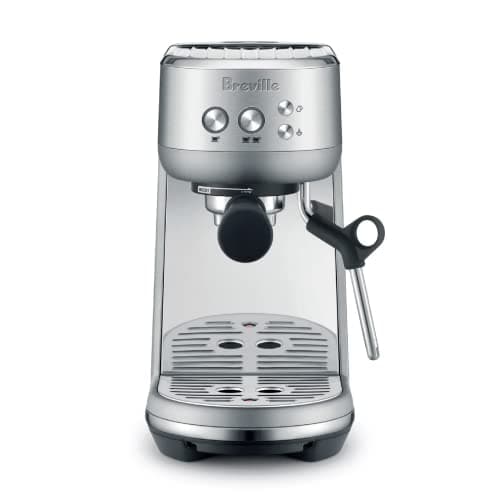 Breville Bambino (BES450)Top pickThe Bambino Plus minus the automatic milk wand. Same 54 mm basket, same 18 g dose, same fast heat-up — you steam the milk. | The same shot for less, if you will texture milk yourself | Semi-automatic, manual milk | |
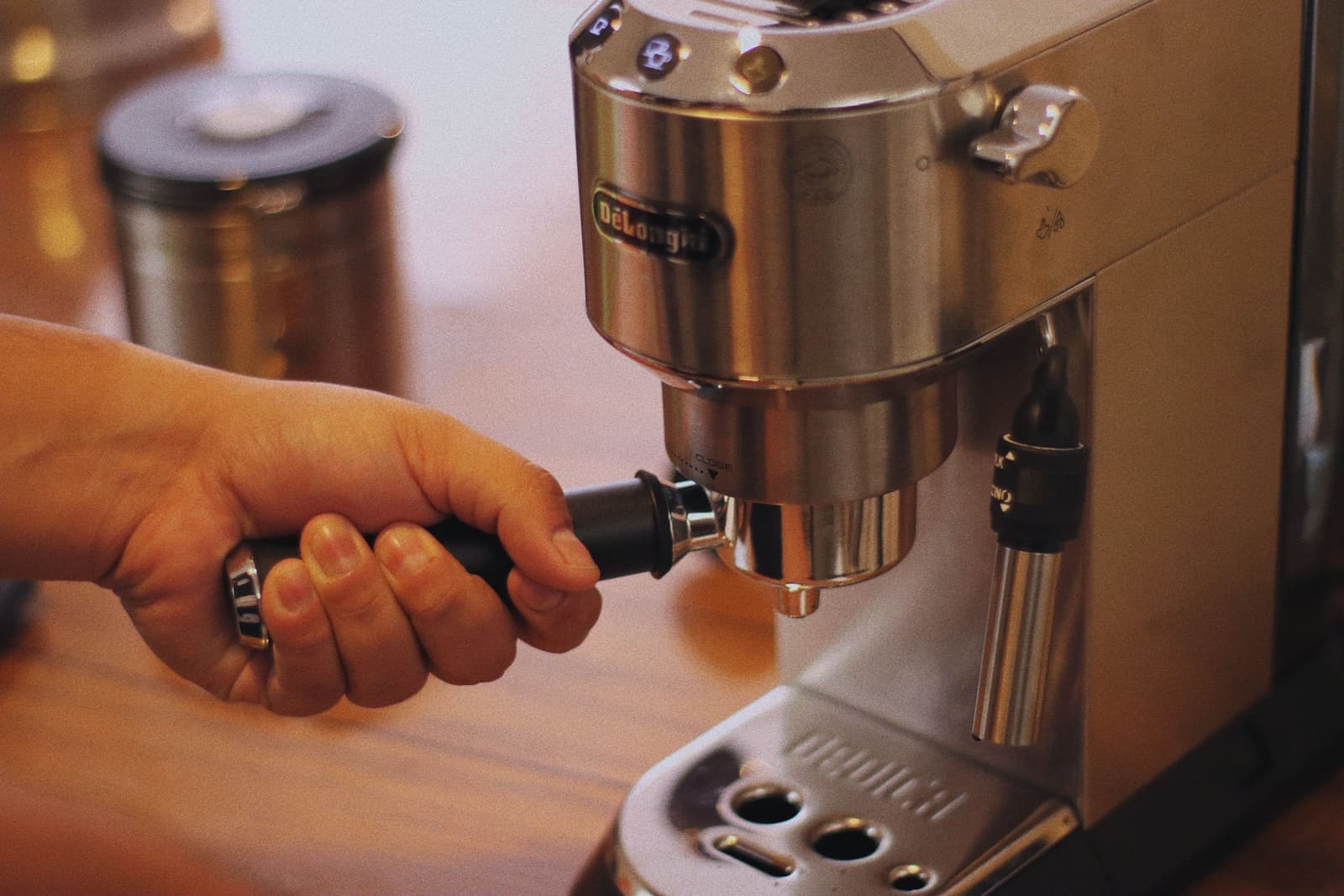
| 2 | 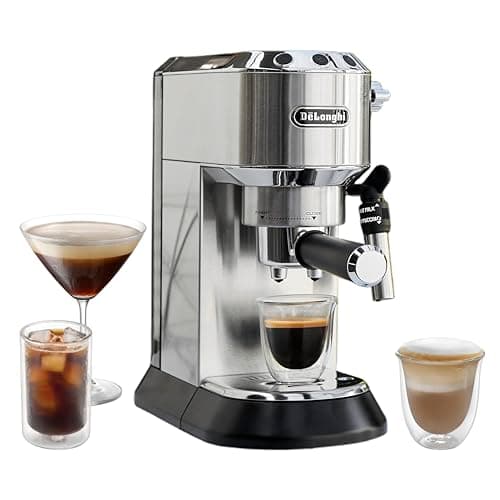 De'Longhi Dedica DeLuxe (EC685)The slim one. De'Longhi states a 15 cm width and calls it the slimmest pump coffee maker they make, which is the whole reason to choose it. | A narrow counter | Compact pump machine | |
| 3 | 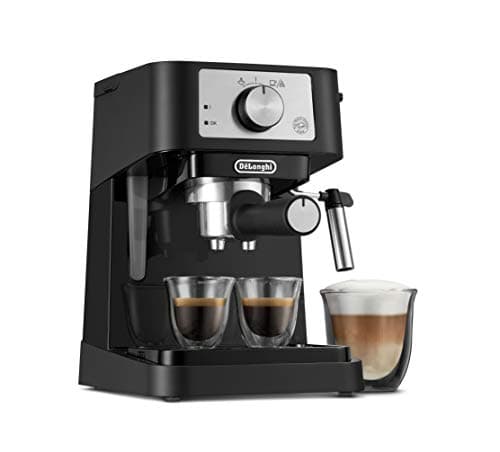 De'Longhi StilosaThe cheapest way to own a pump machine from a brand that will still be there in five years. It is a starting point, not a destination. | Finding out whether you actually want this hobby | Entry pump machine | |
| 4 | 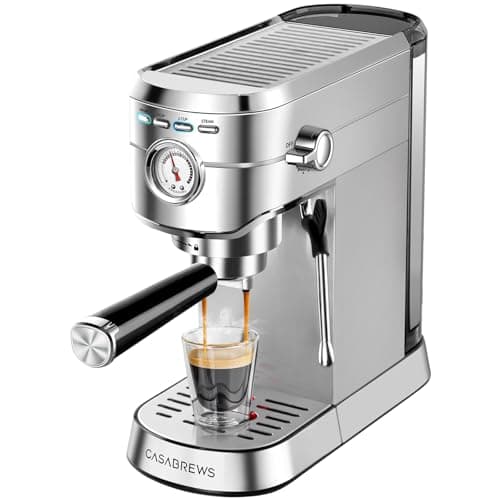 CASABREWS CM5418A budget pump machine of the kind that dominates the low end on Amazon. Useful as an experiment, limited as a destination. | The lowest cash outlay that still has a steam wand | Budget pump machine | |
| 5 | 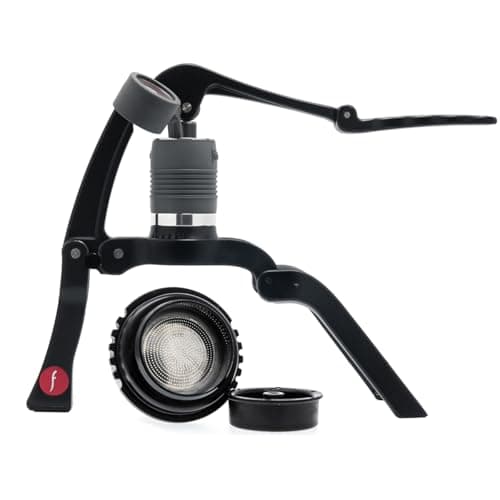 Flair 2GOA manual lever press that collapses into a bag. You supply the pressure and the hot water; it supplies a genuine espresso-style extraction and stores in a drawer. | Real espresso with no electricity and no counter space | Manual lever press | |
We have not handled these units. Everything above comes from published manufacturer documentation, cited inline, plus arithmetic you can redo yourself. Everyone in this category says they tested twenty machines; we have not tested any, and we say so. Here is what we do instead.
01Breville Bambino (BES450)
The same shot for less, if you will texture milk yourself
The Bambino Plus minus the automatic milk wand. Same 54 mm basket, same 18 g dose, same fast heat-up — you steam the milk.
Published specifications for the Breville Bambino (BES450), with sources| Dimensions (W×D×H) | 11.9 × 6.1 × 13.5 in [source] |
|---|
| Portafilter | 54 mm [source] |
|---|
| Stated dose | 18 g [source] |
|---|
| Pump / extraction | 15 bar Italian pump, 9 bar extraction after low-pressure pre-infusion [source] |
|---|
| Heating | ThermoJet [source] |
|---|
| Steam wand | Manual. Breville positions the Plus as the model to choose for an automatic wand [source] |
|---|
Breville's own page frames the difference in one line: choose the Plus if you want the automatic steam wand. Everything about the shot itself is the same.
If you drink espresso black, or mostly americanos, the automatic wand is a feature you would pay for and never use.
If you drink lattes every morning and have never steamed milk, this is the model that will frustrate you first.
What it does well
- The same 54 mm, 18 g, fast-heating shot as the Plus
- Cheaper, which frees money for the grinder — the better place to spend it
- Manual wand teaches you the skill rather than hiding it
What you give up
- Milk texturing is a real skill with a real learning period
- No grinder
Skip it if milk drinks are the whole reason you are buying a machine and you would rather not practice — the Plus exists exactly for that.
02De'Longhi Dedica DeLuxe (EC685)
A narrow counter
The slim one. De'Longhi states a 15 cm width and calls it the slimmest pump coffee maker they make, which is the whole reason to choose it.
Published specifications for the De'Longhi Dedica DeLuxe (EC685), with sources| Width | 15 cm — stated as the slimmest pump coffee maker De'Longhi makes [source] |
|---|
| Pump | 15 bar [source] |
|---|
| Heating | Thermoblock [source] |
|---|
| Filter holder | Takes ground coffee (1 or 2 cups) and E.S.E. pods [source] |
|---|
| Milk | Adjustable frothing wand / cappuccino system [source] |
|---|
Fifteen centimeters of width is genuinely unusual and it is why this machine keeps selling. If your counter run is already full, that number decides the purchase before any other spec does.
The E.S.E. pod compatibility is a fair hedge: it means the machine still makes a coffee on the day you have not restocked beans, without committing you to a pod ecosystem.
It uses a smaller basket than the 54 mm standard, so accessories and recipes written for 54 mm machines will not transfer directly.
What it does well
- Fits where nothing else fits
- Takes ground coffee or E.S.E. pods
- Adjustable frothing wand rather than a fixed panarello
What you give up
- Non-standard basket size limits accessory choice
- Narrow body means a small water tank and frequent refills
Skip it if counter width is not actually your constraint — you are paying for the one thing it is best at and giving up basket standardization to get it.
03De'Longhi Stilosa
Finding out whether you actually want this hobby
The cheapest way to own a pump machine from a brand that will still be there in five years. It is a starting point, not a destination.
We have not compiled a cited spec sheet for this pick yet, so there is no spec table here. What follows is about fit — who it is for and who it is not — not about numbers we cannot source. See how we pick.
Machines at this price ship with pressurized baskets, which force crema regardless of grind. That is a feature if you are grinding with something inadequate and a ceiling once you are not.
The honest way to buy at this level is to treat the machine as the cheap half of the setup and put the money into the grinder, because the grinder is what you will keep.
What it does well
- The lowest-risk way to find out if you want a machine at all
- Forgiving of a mediocre grind while you are still learning
What you give up
- A pressurized basket hides what your grind is actually doing
- You will feel the ceiling within months if you enjoy it
Skip it if you already know you want this — the money is better spent once, on a machine with a standard basket, than twice.
04CASABREWS CM5418
The lowest cash outlay that still has a steam wand
A budget pump machine of the kind that dominates the low end on Amazon. Useful as an experiment, limited as a destination.
Published specifications for the CASABREWS CM5418, with sources| Pump | 20 bar Italian pump [source] |
|---|
| Power | 1350 W [source] |
|---|
| Temperature control | Stated as PID temperature control [source] |
|---|
| Heat-up time | Stated 1 minute [source] |
|---|
| Water tank | 34 oz, removable [source] |
|---|
| Portafilter | 51 mm aluminum [source] |
|---|
| Baskets | Pressurized (dual-wall) only — 1-cup and 2-cup [source] |
|---|
| Steam wand | Stainless steel, manual, mechanical valve [source] |
|---|
| Gauge | Built-in pressure gauge [source] |
|---|
| Dimensions (W×D×H) | 5.47 × 12.28 × 11.97 in [source] |
|---|
| Warranty | 1 year, parts and labor [source] |
|---|
Machines in this bracket advertise a high bar number. Bar is pump pressure, not shot quality — espresso is brewed at around 9 bar, and a 20 bar pump is only a bigger pump.
The specification that actually decides what this machine can do is the basket. CASABREWS lists pressurized dual-wall baskets only, which means the machine generates its own back-pressure and will make a crema-topped shot from almost any grind — and will not reward a better grinder if you buy one.
Treat this as the cheapest possible way to learn whether you like the ritual, with the expectation that you will replace it if you do.
What it does well
- The smallest amount of money that gets you a wand and a portafilter
- A pressure gauge at this price is genuinely unusual
- CASABREWS publishes a real specification table, which most budget brands do not
- Low regret if the hobby does not stick
What you give up
- Pressurized basket masks grind problems rather than solving them
- 51 mm portafilter — the smallest of the three common sizes, with the thinnest accessory market
- No single-wall basket is listed, so there is no upgrade path inside the machine
- One-year warranty, and build and support are not comparable to an established brand
Skip it if you have already decided you want espresso. Buying twice costs more than buying once.
05Flair 2GO
Real espresso with no electricity and no counter space
A manual lever press that collapses into a bag. You supply the pressure and the hot water; it supplies a genuine espresso-style extraction and stores in a drawer.
Published specifications for the Flair 2GO, with sources| Dimensions, assembled | 12 × 9 × 6 in [source] |
|---|
| Dimensions, folded | 3.5 × 7 × 3.25 in (89 × 178 × 83 mm) [source] |
|---|
| Case | 9.5 × 5.25 × 4 in [source] |
|---|
| Weight | 4 lbs [source] |
|---|
| Dose | 12–18 g [source] |
|---|
| Water capacity | 60 ml, for a 45 ml yield [source] |
|---|
| Brew pressure | Stated as 6–9 bar [source] |
|---|
A lever press is the cheapest route to a real, dial-in-able espresso extraction, because you are the pump.
It makes one shot at a time and needs a kettle, so it is a poor fit for a household making four drinks before work.
What it does well
- No electricity, no descaling, no footprint
- Genuine control over pressure and timing
- Cheaper than any pump machine with comparable control
What you give up
- One shot at a time, with a kettle and a preheat
- No steam wand — milk needs a separate frother
Skip it if you make several milk drinks on a weekday morning. The throughput is genuinely low and no technique fixes that.
How to split $500 between machine and grinder
Three ways to spend the same $500| Split | What you get | What happens in month two |
|---|
| $500 machine, $0 grinder | A capable machine and pre-ground supermarket coffee | Fast, sour shots you cannot fix. The pressurized basket hides it for a while. |
| $300 machine, $200 grinder | A solid entry machine and a grinder with real espresso adjustment | You can actually dial in. This is the split we would choose. |
| $150 machine, $350 grinder | A basic machine and a grinder well above it | Very good coffee, and the grinder carries over when you upgrade the machine. |
The third row is not a joke. The grinder is the part you keep. A machine has seals and a pump; a grinder has burrs and a body, and the good ones outlast several machines. Start at grinders under $200 for the options that fit this budget.
What under $500 does and does not buy
- **It does buy** a standard 54 mm basket, fast heat-up, and a steam wand that can texture milk properly.
- **It does buy** an automatic milk wand if you choose it over other features — that is the Bambino Plus trade.
- **It does not buy** a dual boiler, so you wait between pulling a shot and steaming milk.
- **It does not buy** a built-in grinder worth having at the same time. Machines that include one at this price are stretching.
- **It does not buy** plumbing, a pressure gauge, or PID temperature control — with the exception of what the under $1,000 bracket adds.
The one thing to check before you buy
Measure your counter, including the height to the cupboard above it. A machine with a top-loading water tank needs clearance to open the lid, and a 14-inch-tall machine under a 15-inch shelf is a machine you fill with a jug on your knees. Breville publishes dimensions for the Bambino Plus at 11.9 by 7.4 by 14.3 inches; De'Longhi's argument for the Dedica is that it is 15 cm wide, which is unusually narrow. Those two numbers decide more purchases than any spec on the box. Compact espresso machines ranks the small-footprint options and records which makers publish a dimension at all.
Questions people actually ask
Can you make real espresso with a machine under $500?+−
Yes, provided the grinder is not the weak link. Every machine on this page can produce a genuine 9 bar extraction with an 18 g dose in a single-wall basket. What decides the result is whether the coffee going into that basket was ground fine enough and evenly enough.
Is a $300 machine plus a $200 grinder better than a $500 machine?+−
In our view, clearly yes. The grind is the input to everything else — an uneven or too-coarse grind produces channeling and a sour, fast shot that no machine can correct. Read why the grinder comes first.
Do any machines under $500 have a built-in grinder?+−
Some, but at this price the built-in grinder is usually the compromised part. If a single footprint is what you need, look at all-in-one machines and be honest about the budget it takes to do that well.
What about the machines advertising 20 bar for under $150?+−
They exist and they will make coffee. Bar is pump pressure, not shot quality — espresso brews at around 9 bar. Those machines are on the under $200 page with the trade-offs spelled out.