One is ready before the kettle. The other holds temperature better and takes two minutes to think about it. For a first machine that difference decides more than the shot does.
Heads up: we earn a commission if you buy through the links on this page, at no extra cost to you. It never changes the order of the list. Full disclosure · how we pick.
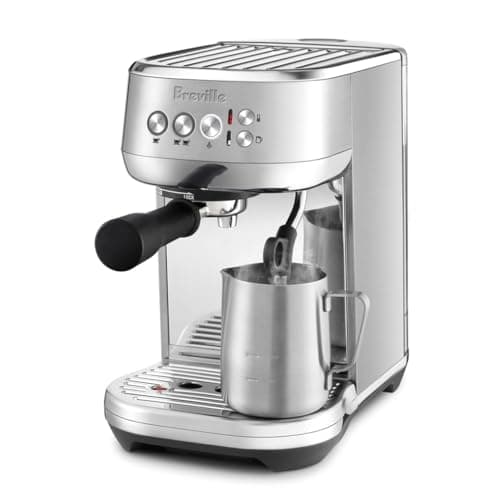
**For a first espresso machine, buy the thermoblock.** Breville states that the Bambino Plus's ThermoJet reaches extraction temperature in three seconds, and a machine that is ready before you have ground the coffee is a machine you use on a Tuesday. A boiler machine like the Gaggia Classic Pro is the better buy in one specific case — you want a 58 mm basket and a machine you can keep repairing — and it asks you to wait for heat-up and to wait again between brewing and steaming.
That is the whole answer. The rest of this page is why it is the answer, what each heating system actually does, and which of the four machines below fits which buyer.
What the two words mean
A **boiler** is a tank of water that the machine keeps hot. Water sits in it, reaches temperature, and stays there. A **thermoblock** (Breville calls its version ThermoJet, and the thermocoil is the same idea) heats water as it flows through a metal block, on demand, so almost nothing is stored.
Every machine on this page is a single-heater design: one heating element does brewing and steaming, not both at once. Dual boilers and heat exchangers — two separate circuits, so you can pull a shot and steam milk simultaneously — exist above this market and are a different purchase. Nothing on this site needs them.
How we judged them
**Time from cold to a shot.** The single figure that decides whether espresso becomes a habit or a weekend project.
**The wait between brewing and steaming.** A one-heater machine has to change temperature to make steam. A boiler changes slowly; a thermoblock changes fast.
**Temperature stability during the shot.** Where boilers have the theoretical advantage, and where published PID control closes most of the gap.
**What is inside it in five years.** A thermoblock is a sealed part. A boiler is a vessel with gaskets, and gaskets are replaceable.
**What the maker actually publishes.** We compare stated figures, not reviewer estimates — and where a maker publishes nothing, this page says so instead of guessing.
What each heating system does, and what it costs you
Thermoblock / ThermoJet / thermocoil
Single boiler
Ready from cold
Seconds — Breville states 3 seconds for ThermoJet
Minutes, and longer again if you want the group head warm
Brew to steam
Fast, because there is very little metal and water to reheat
A wait while the same vessel climbs to steam temperature
Steam power
Adequate for one or two drinks
Stronger and longer-lasting, which matters when you make four
Temperature stability
Depends on control; Breville publishes PID on the Barista Express at a stated 200°F
High thermal mass holds temperature well once it is settled
Scale exposure
Narrow passages, so descaling on schedule matters more
A larger vessel, more tolerant of a missed descale
Serviceability
A sealed assembly — generally replaced, not repaired
Gaskets and valves are consumable parts; Gaggia sells its group gasket directly
Quick picks — Thermoblock vs boiler espresso machines
#
Pick
Best for
Type
Price
1
Breville Bambino Plus (BES500)Top pickThe standard answer to “which first machine” — full 54 mm portafilter and an 18 g dose, with the milk step automated so a flat white is possible on day one.
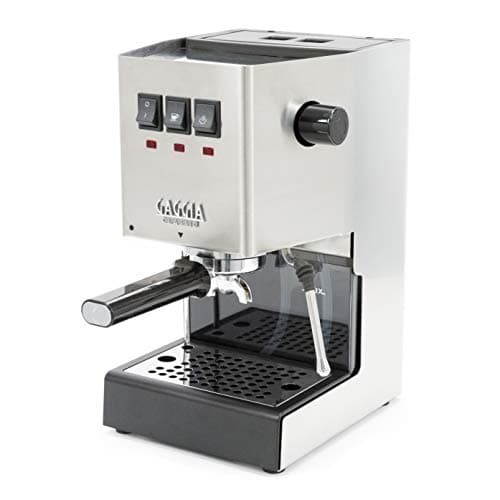
Gaggia Classic Pro E24The current Gaggia Classic: the same commercial-size 58 mm portafilter the line is known for, now with a lead-free brass boiler and a fully published spec sheet.
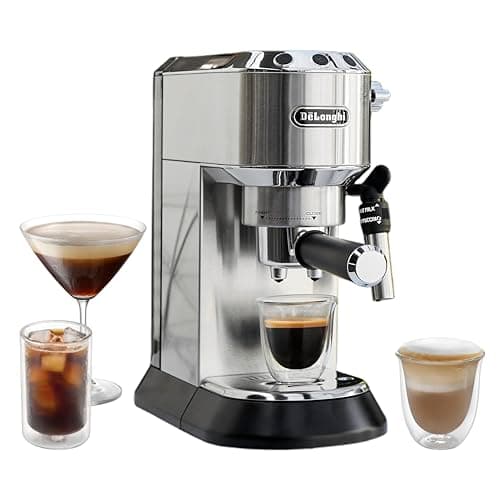
De'Longhi Dedica DeLuxe (EC685)The slim one. De'Longhi states a 15 cm width and calls it the slimmest pump coffee maker they make, which is the whole reason to choose it.
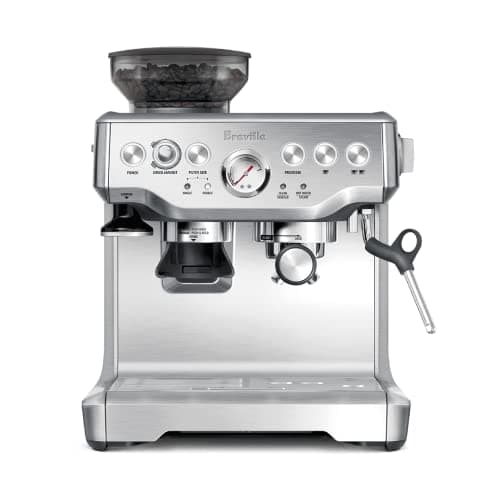
Breville Barista Express (BES870)The default all-in-one: a conical burr grinder with 16 settings built into a machine with a 54 mm basket and PID-controlled temperature.
One box, one counter footprint, machine and grinder together
We have not handled these units. Everything above comes from published manufacturer documentation, cited inline, plus arithmetic you can redo yourself. Everyone in this category says they tested twenty machines; we have not tested any, and we say so. Here is what we do instead.
01
Breville Bambino Plus (BES500)
A first machine you will not outgrow in a year
The standard answer to “which first machine” — full 54 mm portafilter and an 18 g dose, with the milk step automated so a flat white is possible on day one.
Published specifications for the Breville Bambino Plus (BES500), with sources
54 mm tamper, Razor dosing tool, 16 fl oz milk jug, single- and dual-wall baskets, cleaning tool and disc [source]
The 54 mm portafilter and 18 g dose matter more than they sound: they put the machine on the same dose a cafe uses, so any recipe you read applies to it directly and every 54 mm accessory fits.
The three-second heat-up is the difference between espresso being a weekday habit and a weekend project. A machine that takes fifteen minutes to be ready is a machine you use on Sundays.
The automatic steam wand is the single biggest reason this suits a first setup. Milk texturing is the skill that takes longest to learn; handing it to the machine removes the part most likely to make you give up.
What it does well
Standard 54 mm basket, so recipes and accessories from anywhere fit
Ready in seconds, which is what makes it a habit rather than a project
Automatic milk means a drinkable cappuccino before you can texture by hand
The manual wand is still there when you want to learn
What you give up
No grinder — budget for one separately, and that is the right trade
Small water tank compared with a bean-to-cup machine; refills are frequent
Nothing here helps if your grinder cannot go fine enough
Skip it if you want one box that does everything with no learning curve — a bean-to-cup machine is the honest answer for that, and it is a different product.
The current Gaggia Classic: the same commercial-size 58 mm portafilter the line is known for, now with a lead-free brass boiler and a fully published spec sheet.
Published specifications for the Gaggia Classic Pro E24, with sources
The 9-bar figure is the one that matters and Gaggia states it twice — as the brew pressure and as the OPV calibration. Most machines advertise only the 15-bar pump maximum, which is not the pressure at the coffee. This is the same number a cafe machine brews at.
A 3.5 oz brass boiler is small, so it heats quickly and runs out of steam quickly. It is a single boiler, which means brewing and steaming are separate operations with a wait between them.
Everything here is serviceable. The Classic's internals have been broadly the same for years, parts are sold openly, and the modification community around it is the largest of any home machine — which is the real argument for buying one.
What it does well
58 mm commercial-standard portafilter, so every accessory fits
Gaggia publishes brew pressure, boiler material and OPV calibration
Serviceable, well-documented internals with an unusually large parts supply
What you give up
No PID from the factory — brew temperature is not held or displayed
Single small boiler: brew, then wait, then steam
Nothing is automated, including the milk
Skip it if you want the machine to help you. It does exactly what you tell it, including when what you told it was wrong.
Takes ground coffee (1 or 2 cups) and E.S.E. pods [source]
Milk
Adjustable frothing wand / cappuccino system [source]
Fifteen centimeters of width is genuinely unusual and it is why this machine keeps selling. If your counter run is already full, that number decides the purchase before any other spec does.
The E.S.E. pod compatibility is a fair hedge: it means the machine still makes a coffee on the day you have not restocked beans, without committing you to a pod ecosystem.
It uses a smaller basket than the 54 mm standard, so accessories and recipes written for 54 mm machines will not transfer directly.
What it does well
Fits where nothing else fits
Takes ground coffee or E.S.E. pods
Adjustable frothing wand rather than a fixed panarello
What you give up
Non-standard basket size limits accessory choice
Narrow body means a small water tank and frequent refills
Skip it if counter width is not actually your constraint — you are paying for the one thing it is best at and giving up basket standardization to get it.
Sixteen grind settings is the number to weigh. It is enough to find an espresso grind, and it is not enough to make small corrections once you are close — which is exactly the trade-off you accept for the convenience of one box.
PID temperature control at a stated 200°F is a genuine feature and not a marketing word: it means the water temperature is held rather than allowed to drift between shots.
The footprint argument is the strongest one here. A separate machine and grinder need roughly twice the counter, and on a small kitchen counter that decides it.
What it does well
Machine and grinder in one footprint, which is often the real constraint
Grinds straight into the portafilter — no transfer, no mess step
PID-held brew temperature
Manual wand, so milk skill is learnable on it
What you give up
Sixteen settings is coarse resolution once you are dialing in
The grinder cannot be upgraded independently of the machine
Bigger and heavier than a standalone machine
Skip it if you already own a decent burr grinder — you would be paying twice for the same job, and a separate machine plus your existing grinder will beat it.
Because the failure mode of a first espresso setup is not a bad shot. It is the machine going unused.
A boiler machine that needs ten or fifteen minutes to be properly warm gets used at weekends, and a machine used at weekends never gets dialed in, because dialing in is a process of small corrections made often. Breville's stated three seconds removes that entirely — you decide you want coffee and the machine is already there.
The second reason is milk. On one heater, every milk drink means a temperature change. The Bambino Plus goes from brewing to steaming quickly enough that the two feel like one operation; on a boiler machine you brew, wait, steam, and then wait again to brew the next one. If you are making one flat white, that is an annoyance. If you are making two, it is the reason you stop bothering.
When a boiler is the right answer
One case, and it is a real one: you want a machine built to commercial dimensions that you can keep running for a long time.
Gaggia publishes a solid lead-free brass boiler for the Classic Pro E24, a 58 mm stainless portafilter, a 15 bar Ulka pump with the OPV calibrated to 9 bar, and a 72 oz tank. Brass is the point: it is thermally stable, and the whole machine is assembled rather than sealed, so the wear parts are parts. Gaggia sells the group gasket and the two-way valve pin on its own site, which is a thing almost no maker in this price bracket does.
PID is temperature control, not a heating system — it can sit on either. It holds the water closer to a target instead of letting it swing between a thermostat's two limits.
Breville publishes thermocoil with PID temperature control at a stated 200°F on the Barista Express. That combination is the practical sweet spot for a beginner: thermoblock speed with the stability a boiler is usually bought for. Gaggia publishes no PID on the Classic Pro, which is one of the reasons people fit one aftermarket.
Heating up is not the same as being ready
A figure like three seconds describes the water, not the machine. The group head, the portafilter and the cup are all cold metal, and cold metal pulls heat straight out of a 25-gram shot on its way through.
This narrows the practical gap between the two systems and it does not close it. On a thermoblock machine, running a blank shot through the empty portafilter warms the whole path in about twenty seconds, so you are genuinely ready in well under a minute. On a boiler machine you are waiting for the vessel regardless, and warming the portafilter is a thing you do while you wait rather than instead of waiting.
Either way, the habit is the same and it is free: leave the portafilter locked in the group when the machine is idle, and pull a blank shot before the real one. Your first week with an espresso machine builds it in from day one.
The descaling difference, honestly
A thermoblock heats water in narrow channels. Scale narrows them further, and the symptom is a machine that gets slower and then stops. A boiler holds more water in a wider vessel and tolerates neglect for longer before anything goes wrong.
This is not a reason to buy a boiler. It is a reason to descale on schedule and to think about your water, both of which are cheaper than either machine: how to descale, the maintenance schedule and water for espresso cover it.
So which should you buy?
**You want espresso on weekday mornings** — thermoblock, and the Bambino Plus if milk drinks matter.
**You want the narrowest machine that still makes real espresso** — thermoblock, and the Dedica, which De'Longhi states is the slimmest pump coffee maker it makes at 15 cm wide.
**You want the machine and the grinder in one box** — thermocoil with PID, which is the Barista Express.
**You want 58 mm, parts you can buy, and you accept the wait** — the boiler, which is the Gaggia Classic Pro.
**You make four milk drinks back to back, every morning** — you want more steam than any machine here has, and that is a different and more expensive purchase.
We have not used any of these machines. Every figure on this page is published by the manufacturer and linked below, and prices come live from the listings we link to.
Questions people actually ask
Is a thermoblock or a boiler better for espresso?+−
For a first home machine, a thermoblock. It reaches extraction temperature in seconds — Breville states three for its ThermoJet — and moves between brewing and steaming quickly, which is what makes espresso a daily habit rather than a weekend project. A boiler is better if you want a 58 mm commercial basket, stronger steam, and a machine whose gaskets and valves are replaceable parts.
Does a thermoblock machine make worse espresso?+−
No. Breville publishes the same shot specification on its thermoblock machines as you would find on much more expensive equipment: a 54 mm basket, an 18 g dose and 9 bar extraction after low-pressure pre-infusion. Temperature stability is where boilers have the theoretical edge, and published PID control — as on the Barista Express, stated at 200°F — closes most of it.
How long does a boiler espresso machine take to heat up?+−
Minutes rather than seconds, and longer again if you want the group head and portafilter warm, which you do. Gaggia does not publish a heat-up figure for the Classic Pro. The honest way to plan around it is to switch the machine on when you start grinding, not when you want the coffee.
What is the difference between a thermoblock and a thermocoil?+−
Both heat water on demand as it flows through metal rather than storing it hot. A thermocoil runs the water through a tube cast into the block instead of through channels in the block itself. Breville uses thermocoil on the Barista Express and calls its faster system ThermoJet on the Bambino line. For a buyer, they belong in the same category.
Do thermoblock machines need descaling more often?+−
They are less forgiving of a missed descale. Water passes through narrow channels, so scale restricts flow sooner than it would in a larger boiler. Both types need descaling on a schedule; a thermoblock punishes you faster for skipping it.
Can you brew and steam at the same time on these machines?+−
No. Every machine on this page has a single heater, so it does one or the other and changes temperature in between. Simultaneous brewing and steaming needs a heat exchanger or a dual boiler, which sits above this market and is more machine than a first setup needs.
A commercial 58 mm basket and serviceable internals against an automatic milk wand and a three-second heat-up — and how to tell which one is your machine.