Heads up: we earn a commission if you buy through the links on this page, at no extra cost to you. It never changes the order of the list. Full disclosure · how we pick.
**Buy the CASABREWS CM5418 if your real question is whether you enjoy making espresso at all, and you want to find out for the least money possible.** It is the cheapest machine on this site that has a real steam wand and a pressure gauge, and CASABREWS publishes a proper specification table — which most brands in this bracket do not.
Do not buy it if you have already decided you want espresso. One specification settles that: CASABREWS lists pressurized baskets only, so the machine cannot reward a better grinder, and there is no upgrade path inside it.
What CASABREWS publishes
This matters more than it sounds. The retail listings for this machine disagree with each other across colorways and across the “Pro” and “Max” variants — different tank sizes, different heat-up claims, different portafilters. Everything below comes from CASABREWS's own product page for the CM5418 and nowhere else.
CASABREWS CM5418, as published by CASABREWS| Specification | Stated figure |
|---|
| Pump | 20 bar Italian pump |
| Power | 1350 W |
| Temperature control | Stated as PID temperature control |
| Heat-up time | Stated 1 minute |
| Water tank | 34 oz, removable |
| Portafilter | 51 mm aluminum |
| Baskets | Pressurized (dual-wall) only — 1-cup and 2-cup |
| Steam wand | Stainless steel, manual, mechanical valve |
| Gauge | Built-in pressure gauge |
| Dimensions (W×D×H) | 5.47 × 12.28 × 11.97 in |
| Warranty | 1 year, parts and labor |
CASABREWS does not publish a weight, a heating-element wattage, or what kind of heating system sits behind the PID claim.
Quick picks — CASABREWS CM5418 review| # | Pick | Best for | Type | Price |
|---|
| 1 | 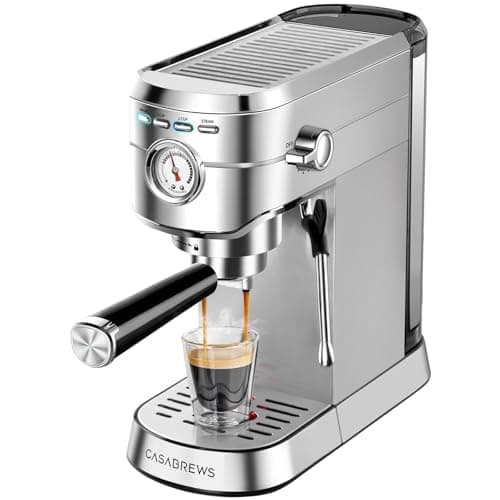 CASABREWS CM5418Top pickA budget pump machine of the kind that dominates the low end on Amazon. Useful as an experiment, limited as a destination. | The lowest cash outlay that still has a steam wand | Budget pump machine | |
| 2 | 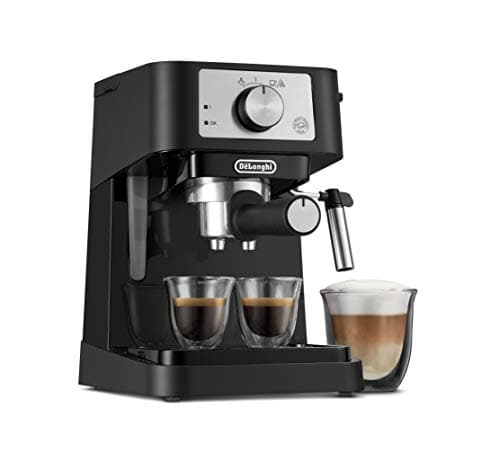 De'Longhi StilosaThe cheapest way to own a pump machine from a brand that will still be there in five years. It is a starting point, not a destination. | Finding out whether you actually want this hobby | Entry pump machine | |
| 3 | 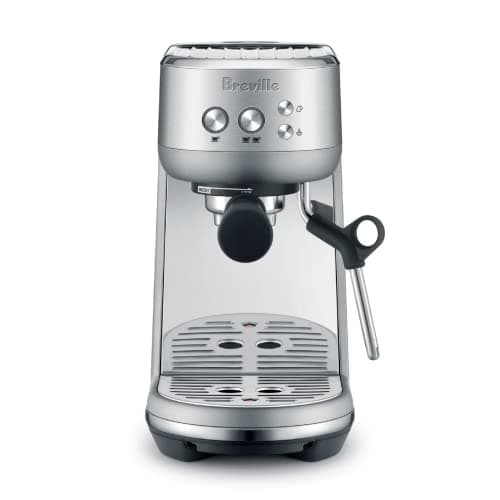 Breville Bambino (BES450)The Bambino Plus minus the automatic milk wand. Same 54 mm basket, same 18 g dose, same fast heat-up — you steam the milk. | The same shot for less, if you will texture milk yourself | Semi-automatic, manual milk | |
| 4 | 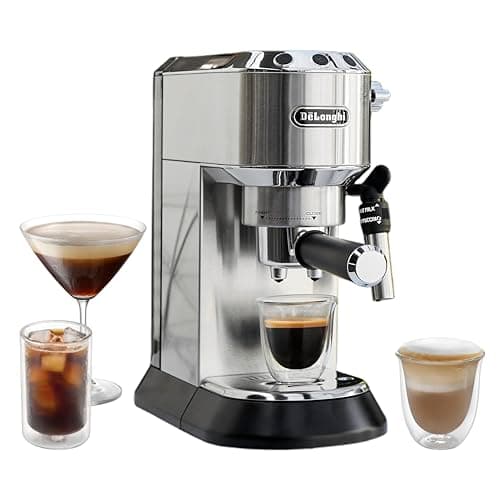 De'Longhi Dedica DeLuxe (EC685)The slim one. De'Longhi states a 15 cm width and calls it the slimmest pump coffee maker they make, which is the whole reason to choose it. | A narrow counter | Compact pump machine | |
We have not handled these units. Everything above comes from published manufacturer documentation, cited inline, plus arithmetic you can redo yourself. Everyone in this category says they tested twenty machines; we have not tested any, and we say so. Here is what we do instead.
01CASABREWS CM5418
The lowest cash outlay that still has a steam wand
A budget pump machine of the kind that dominates the low end on Amazon. Useful as an experiment, limited as a destination.
Published specifications for the CASABREWS CM5418, with sources| Pump | 20 bar Italian pump [source] |
|---|
| Power | 1350 W [source] |
|---|
| Temperature control | Stated as PID temperature control [source] |
|---|
| Heat-up time | Stated 1 minute [source] |
|---|
| Water tank | 34 oz, removable [source] |
|---|
| Portafilter | 51 mm aluminum [source] |
|---|
| Baskets | Pressurized (dual-wall) only — 1-cup and 2-cup [source] |
|---|
| Steam wand | Stainless steel, manual, mechanical valve [source] |
|---|
| Gauge | Built-in pressure gauge [source] |
|---|
| Dimensions (W×D×H) | 5.47 × 12.28 × 11.97 in [source] |
|---|
| Warranty | 1 year, parts and labor [source] |
|---|
Machines in this bracket advertise a high bar number. Bar is pump pressure, not shot quality — espresso is brewed at around 9 bar, and a 20 bar pump is only a bigger pump.
The specification that actually decides what this machine can do is the basket. CASABREWS lists pressurized dual-wall baskets only, which means the machine generates its own back-pressure and will make a crema-topped shot from almost any grind — and will not reward a better grinder if you buy one.
Treat this as the cheapest possible way to learn whether you like the ritual, with the expectation that you will replace it if you do.
What it does well
- The smallest amount of money that gets you a wand and a portafilter
- A pressure gauge at this price is genuinely unusual
- CASABREWS publishes a real specification table, which most budget brands do not
- Low regret if the hobby does not stick
What you give up
- Pressurized basket masks grind problems rather than solving them
- 51 mm portafilter — the smallest of the three common sizes, with the thinnest accessory market
- No single-wall basket is listed, so there is no upgrade path inside the machine
- One-year warranty, and build and support are not comparable to an established brand
Skip it if you have already decided you want espresso. Buying twice costs more than buying once.
02De'Longhi Stilosa
Finding out whether you actually want this hobby
The cheapest way to own a pump machine from a brand that will still be there in five years. It is a starting point, not a destination.
We have not compiled a cited spec sheet for this pick yet, so there is no spec table here. What follows is about fit — who it is for and who it is not — not about numbers we cannot source. See how we pick.
Machines at this price ship with pressurized baskets, which force crema regardless of grind. That is a feature if you are grinding with something inadequate and a ceiling once you are not.
The honest way to buy at this level is to treat the machine as the cheap half of the setup and put the money into the grinder, because the grinder is what you will keep.
What it does well
- The lowest-risk way to find out if you want a machine at all
- Forgiving of a mediocre grind while you are still learning
What you give up
- A pressurized basket hides what your grind is actually doing
- You will feel the ceiling within months if you enjoy it
Skip it if you already know you want this — the money is better spent once, on a machine with a standard basket, than twice.
03Breville Bambino (BES450)
The same shot for less, if you will texture milk yourself
The Bambino Plus minus the automatic milk wand. Same 54 mm basket, same 18 g dose, same fast heat-up — you steam the milk.
Published specifications for the Breville Bambino (BES450), with sources| Dimensions (W×D×H) | 11.9 × 6.1 × 13.5 in [source] |
|---|
| Portafilter | 54 mm [source] |
|---|
| Stated dose | 18 g [source] |
|---|
| Pump / extraction | 15 bar Italian pump, 9 bar extraction after low-pressure pre-infusion [source] |
|---|
| Heating | ThermoJet [source] |
|---|
| Steam wand | Manual. Breville positions the Plus as the model to choose for an automatic wand [source] |
|---|
Breville's own page frames the difference in one line: choose the Plus if you want the automatic steam wand. Everything about the shot itself is the same.
If you drink espresso black, or mostly americanos, the automatic wand is a feature you would pay for and never use.
If you drink lattes every morning and have never steamed milk, this is the model that will frustrate you first.
What it does well
- The same 54 mm, 18 g, fast-heating shot as the Plus
- Cheaper, which frees money for the grinder — the better place to spend it
- Manual wand teaches you the skill rather than hiding it
What you give up
- Milk texturing is a real skill with a real learning period
- No grinder
Skip it if milk drinks are the whole reason you are buying a machine and you would rather not practice — the Plus exists exactly for that.
04De'Longhi Dedica DeLuxe (EC685)
A narrow counter
The slim one. De'Longhi states a 15 cm width and calls it the slimmest pump coffee maker they make, which is the whole reason to choose it.
Published specifications for the De'Longhi Dedica DeLuxe (EC685), with sources| Width | 15 cm — stated as the slimmest pump coffee maker De'Longhi makes [source] |
|---|
| Pump | 15 bar [source] |
|---|
| Heating | Thermoblock [source] |
|---|
| Filter holder | Takes ground coffee (1 or 2 cups) and E.S.E. pods [source] |
|---|
| Milk | Adjustable frothing wand / cappuccino system [source] |
|---|
Fifteen centimeters of width is genuinely unusual and it is why this machine keeps selling. If your counter run is already full, that number decides the purchase before any other spec does.
The E.S.E. pod compatibility is a fair hedge: it means the machine still makes a coffee on the day you have not restocked beans, without committing you to a pod ecosystem.
It uses a smaller basket than the 54 mm standard, so accessories and recipes written for 54 mm machines will not transfer directly.
What it does well
- Fits where nothing else fits
- Takes ground coffee or E.S.E. pods
- Adjustable frothing wand rather than a fixed panarello
What you give up
- Non-standard basket size limits accessory choice
- Narrow body means a small water tank and frequent refills
Skip it if counter width is not actually your constraint — you are paying for the one thing it is best at and giving up basket standardization to get it.
The 20 bar number
Ignore it. Espresso is brewed at around 9 bar, and 20 bar is the pump's maximum rather than the pressure at the coffee — Breville and Gaggia both publish 15 bar pumps with 9 bar extraction. A bigger pump number is not a better shot, and the machines that advertise the biggest numbers are usually the ones that do not publish a brew pressure at all. What pump pressure actually means is the full version.
What is genuinely unusual here is the gauge. At this price almost nothing has one, and a needle that responds to your grind teaches you more than any number on the box. The caveat comes next.
The basket is the whole review
CASABREWS lists two baskets, both dual-wall, which is the same thing as pressurized. A pressurized basket has a second wall with a single small hole in it, and that hole — not your coffee — creates most of the resistance the pump works against.
The consequence is specific and worth being clear about. A pressurized basket will produce a crema-topped shot from supermarket pre-ground coffee and a blade grinder, which is exactly why budget machines ship with them. It will also produce roughly the same shot from a $300 grinder, because the basket is doing the work either way. The ceiling is set by the hardware, not by your technique.
It also makes the gauge less informative than it looks: the needle is reading the basket's fixed restriction as much as the puck's. Pressurized vs non-pressurized baskets explains the switch most machines let you make — and this one does not, because CASABREWS lists no single-wall basket for it.
The 51 mm problem
Three portafilter sizes matter at home: 51, 54 and 58 mm. The accessory market is built for 58 mm first and 54 mm second. At 51 mm, your choice of tampers, distribution tools, puck screens and especially single-wall baskets is thin, and a bottomless portafilter — the diagnostic tool that shows you what your puck is actually doing — is hard to find at all.
So the size compounds the basket problem. Even if you wanted to work around the pressurized basket by buying a single-wall replacement, 51 mm is the size where that is hardest. Portafilter sizes covers how much this constrains you.
What it does well
- **It costs very little and it has a real steam wand.** Stainless, manual, with a mechanical valve. You can learn to texture milk on it, and milk texturing is a transferable skill — it moves with you to whatever you buy next.
- **One minute from cold, as stated.** Slower than Breville's three seconds, far faster than any boiler machine, and fast enough for a weekday.
- **It publishes its specifications.** CASABREWS states the pump, the power, the tank, the portafilter, the basket type and the warranty. Several better-known budget brands state almost none of that.
- **A 34 oz removable tank.** Small, and removable is the part that matters — you fill it at the sink rather than pouring into the machine.
- **Low regret.** If the hobby does not stick, you have spent about what a good tamper costs.
What it does not do
- **It does not improve.** Pressurized baskets only, 51 mm, no published single-wall option. A better grinder, a better tamper and better beans will each do less here than on any other machine we feature.
- **It does not tell you whether you are good at this.** The basket flatters every shot equally, which is the point of it and also the limit of it.
- **It is not a long-term machine.** One-year warranty, and no published parts program.
- **It will not make you a second drink quickly.** One heater, a manual wand, and a small tank.
Who should buy it
One buyer, clearly: the person who thinks they might want espresso, does not want to spend $300 to find out, and will be honest with themselves about replacing it if the answer is yes. Used as a one-year experiment, it is a sensible purchase and we would not talk anyone out of it.
It is also a reasonable choice for someone who wants milk drinks cheaply and does not especially care about the espresso underneath them — a wand is a wand, and a cappuccino made from a pressurized-basket shot is a perfectly decent cappuccino.
Who should not
Anyone who already knows they want espresso. The arithmetic is unkind: this machine plus the machine you buy afterwards costs more than buying once, and the usual trigger for buying twice is realising six months in that the basket is the ceiling. Is an espresso machine worth it? works that through with the numbers shown.
Anyone who already owns a capable grinder should also skip it — you would be pairing a grinder that can make fine adjustments with a basket that cannot use them.
What to buy instead, at each step up
- **De'Longhi Stilosa.** A step up in brand support at close to the same money, from a maker with a US parts and service presence. Still a budget machine with the same basket philosophy.
- **Breville Bambino.** The first real jump: a 54 mm basket, a stated 18 g dose, a 15 bar pump with 9 bar extraction, and ThermoJet heating. Breville includes both single-wall and dual-wall baskets, so the upgrade path is in the box. You texture the milk yourself.
- **De'Longhi Dedica.** If width is the constraint — De'Longhi states 15 cm, the slimmest pump machine it makes.
Best espresso machines under $200 and Breville Bambino alternatives cover the rest of this bracket.
The verdict
A fair machine honestly specified, sold into a bracket where most machines are neither. It will make you a hot, crema-topped coffee tomorrow morning and it will never make you a better one than it makes on day one. Buy it as a question, not as an answer.
We have not used this machine. Every figure here is published by CASABREWS and linked below, and the price comes live from the listing we link to.
Questions people actually ask
Is the CASABREWS CM5418 a good espresso machine?+−
It is a good machine for one purpose: finding out cheaply whether you enjoy making espresso. It has a real stainless steam wand, a pressure gauge, a stated one-minute heat-up and a published specification sheet, which is more than most machines at the price. It is a poor long-term machine because CASABREWS lists pressurized baskets only, so it cannot make use of a better grinder.
Does the CASABREWS CM5418 come with a non-pressurized basket?+−
No. CASABREWS lists two baskets, a 1-cup and a 2-cup, and describes both as dual-wall — that is, pressurized. No single-wall basket is listed for the machine, and at 51 mm the aftermarket for one is thin.
Is 20 bar better than 15 bar on the CM5418?+−
No. Espresso is brewed at around 9 bar, and both figures are pump maximums rather than brew pressure. Breville and Gaggia both publish 15 bar pumps with 9 bar at the coffee. The 20 bar rating tells you the pump is strong enough, which every pump in this category is.
What size portafilter does the CASABREWS CM5418 use?+−
CASABREWS states a 51 mm aluminum portafilter. That is the smallest of the three common home sizes and the one with the thinnest accessory market — tampers, distribution tools and replacement baskets are all easier to find in 54 mm and 58 mm.
How long does the CASABREWS CM5418 take to heat up?+−
CASABREWS states one minute. For comparison, Breville states three seconds for the ThermoJet system in the Bambino line, and boiler machines such as the Gaggia Classic Pro take several minutes and publish no figure.
Should I buy the CM5418 or save for a Breville Bambino?+−
If you already know you want espresso, save for the Bambino. It has a 54 mm basket, a stated 18 g dose and both basket types in the box, so it still makes sense once your grinder improves. Buy the CM5418 only if the question you are really answering is whether you want to do this at all.