Heads up: we earn a commission if you buy through the links on this page, at no extra cost to you. It never changes the order of the list. Full disclosure · how we pick.
This is the accessory most people buy on looks, and there is one genuine engineering problem underneath it. A double shot is about 36 grams of liquid — roughly two tablespoons — at around 90°C, going into a room-temperature ceramic object that weighs five to ten times as much as the drink does.
The cup wins that exchange. How badly it wins is what separates a good espresso cup from a mug, and it is why the same shot can taste noticeably better out of one cup than another.
How we judged these
**Wall thickness.** The single most important property and the one nobody publishes. Thicker walls hold heat; thin ones dump it.
**Volume.** A double shot at the 1:2 ratio the National Coffee Association describes is about 36 g. A cup much over 3 oz makes it look like a puddle and cools it faster.
**Taper.** A narrower base concentrates the crema over less surface area, so it holds rather than spreading and collapsing.
**Whether it survives a real kitchen.** A cup you are afraid of is a cup that stays in the cupboard.
**Whether you can buy another one.** Sets get chipped. Availability matters more than it sounds.
Quick picks — Best espresso cups
#
Pick
Best for
Type
Price
1
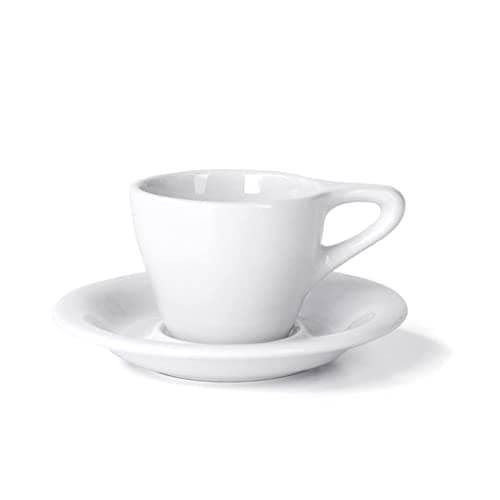
notNeutral LINO Espresso Cup & SaucerTop pickThe specialty-cafe default. Thick-walled porcelain with a tapered interior, sized for a double shot rather than for a cupboard.
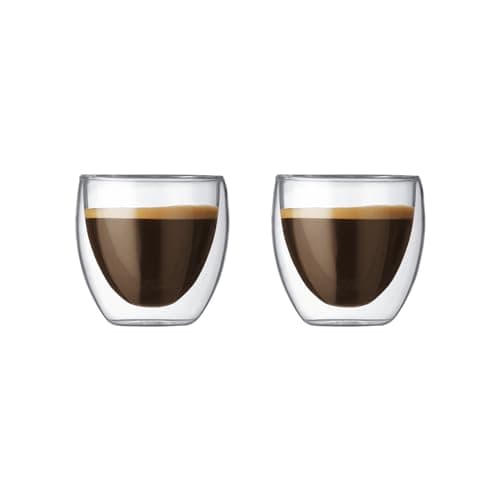
Bodum Pavina Double-Wall GlassesDouble-walled borosilicate. The air gap does the work a thick ceramic wall does, and you get to watch the layers separate.
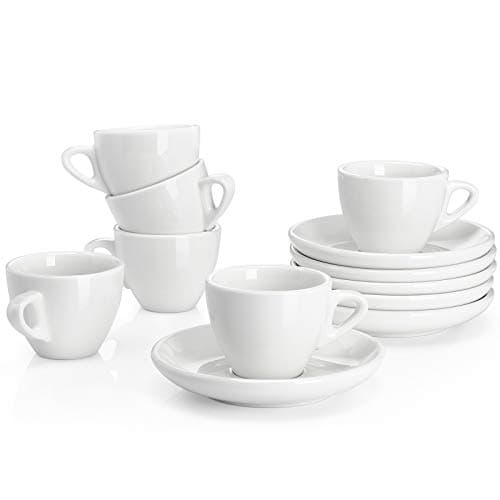
Sweese Porcelain Espresso CupsPlain, sturdy porcelain sold in sets. Not the cup a cafe would choose, and completely adequate for the job at a fraction of the money.
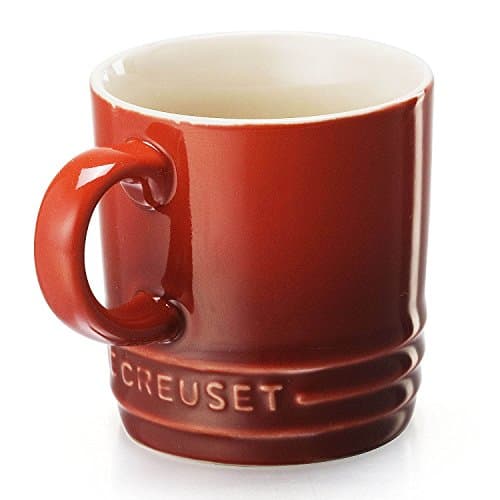
Le Creuset Stoneware Espresso Mug (3 oz)Heavy glazed stoneware at a true 3 oz espresso size. Thick enough to hold heat properly, and priced as a piece of kitchenware rather than as a coffee accessory.
Heat retention, if you want it to look like something
We have not handled these units. Everything above comes from published manufacturer documentation, cited inline, plus arithmetic you can redo yourself. Everyone in this category says they tested twenty machines; we have not tested any, and we say so. Here is what we do instead.
01
notNeutral LINO Espresso Cup & Saucer
The cup cafes actually use
The specialty-cafe default. Thick-walled porcelain with a tapered interior, sized for a double shot rather than for a cupboard.
We have not compiled a cited spec sheet for this pick yet, so there is no spec table here. What follows is about fit — who it is for and who it is not — not about numbers we cannot source. See how we pick.
Wall thickness is the specification that matters and nobody lists it. A thin cup pulls heat out of a 36 g shot almost instantly; a thick one holds it long enough to drink.
The taper matters too. A narrow base keeps crema over a small surface area instead of letting it spread and collapse.
It is a cup. It costs more than a cup should, and it is the one most people end up owning anyway.
What it does well
Genuinely holds heat, which most espresso cups do not
Sized for a real double shot
Sold in enough sizes and colors to build a set
What you give up
Costs several times a supermarket set
Sold as single cups, so a set adds up
Skip it if you drink everything as a latte in a big mug. The whole design brief here is a small, hot, straight shot.
Double-walled borosilicate. The air gap does the work a thick ceramic wall does, and you get to watch the layers separate.
We have not compiled a cited spec sheet for this pick yet, so there is no spec table here. What follows is about fit — who it is for and who it is not — not about numbers we cannot source. See how we pick.
Double-wall glass is the one design that both insulates better than a normal cup and stays see-through, which is why it became the default for showing off a layered drink.
It is also the design most likely to break. The walls are thin borosilicate and they do not survive being knocked into a sink full of cutlery.
For espresso specifically, buy the smallest size. The large ones are latte glasses and a double shot looks lost in them.
What it does well
Good heat retention without a thick wall
You can see the crema and the pour
Lightweight
What you give up
Fragile compared with porcelain
The larger sizes are wrong for straight espresso
Hand wash in practice, whatever the box says
Skip it if your cups live in a busy kitchen with a dishwasher and children. Buy porcelain and keep the money.
Plain, sturdy porcelain sold in sets. Not the cup a cafe would choose, and completely adequate for the job at a fraction of the money.
We have not compiled a cited spec sheet for this pick yet, so there is no spec table here. What follows is about fit — who it is for and who it is not — not about numbers we cannot source. See how we pick.
Buying a set is the practical move. Espresso cups get chipped and they get left at the back of a cupboard with tea in them, and replacing one of a matched pair is annoying.
The trade against a cafe cup is wall thickness and taper. These hold heat less well and the interior is straighter, and in a drink you finish in ninety seconds that is a smaller difference than the price gap suggests.
What it does well
A whole set costs less than one specialty cup
Dishwasher and microwave friendly in normal use
Widely stocked, so replacing one is easy
What you give up
Thinner walls than a cafe cup, so shots cool faster
Straighter interior does the crema no favors
Skip it if you are buying two cups rather than six. At that point the money difference is small and the better cup is worth it.
Heat retention, if you want it to look like something
Heavy glazed stoneware at a true 3 oz espresso size. Thick enough to hold heat properly, and priced as a piece of kitchenware rather than as a coffee accessory.
We have not compiled a cited spec sheet for this pick yet, so there is no spec table here. What follows is about fit — who it is for and who it is not — not about numbers we cannot source. See how we pick.
Thermal mass is real here. A heavy stoneware mug preheated with hot water will keep a double shot drinkable noticeably longer than a thin cup.
It is also heavy and takes up cupboard space, and you are paying a brand premium on top of the function.
Preheat it. An unheated heavy cup is worse than a thin one, because all that mass is pulling heat out of the shot.
What it does well
Excellent heat retention once preheated
Durable in a way thin porcelain is not
Oven and dishwasher safe
What you give up
Expensive for what it does
Heavy, and useless if you skip the preheat
Sold as a single mug, so a set adds up fast
Skip it if you will not preheat. Unheated, its main feature works against you.
The most common mistake is buying a set labeled "espresso" that is actually 4 oz. It will make a fine cortado and it will make a double espresso look like something went wrong.
Preheat the cup. Seriously.
This is free and it makes more difference than upgrading from a cheap cup to an expensive one. Fill the cup with hot water while the machine is warming up, tip it out just before you pull the shot.
The heavier the cup, the more this matters — a thick stoneware mug that has not been preheated is actively worse than a thin porcelain one, because all that thermal mass is pulling heat out of your 36 grams of coffee. Buy heavy and preheat always, or buy light.
Glass or ceramic?
The two materials, honestly
Porcelain / stoneware
Double-wall glass
Heat retention
Good, from wall thickness
Good, from the air gap
Durability
High
Low — thin borosilicate
Shows the shot
No
Yes, which is most of the appeal
Dishwasher
Generally fine
Hand wash in practice
Cost per cup
From very cheap to very not
Middle, and you will replace them
Neither is wrong. Double-wall glass is the better-looking option and the one you will break; porcelain is the one that will still be in the cupboard in five years.
What we would not spend money on
**Thin, wide "espresso" cups.** The worst combination available: maximum surface area, minimum thermal mass.
**Anything with a metal rim.** It conducts heat straight to your lip and it is unpleasant.
**Novelty sets that do not state a volume.** If a listing will not tell you the capacity, that is the answer.
**A matched set of six when you need two.** At two cups, the price gap between budget and good is small enough that the good one is worth it.
And if the money is genuinely tight, put it somewhere it changes the coffee instead. A cup improves the last ten seconds of the drink; a grinder decides whether the drink was worth making. What you can skip has the full ordering.
Questions people actually ask
What size should an espresso cup be?+−
2 to 3 oz (60-90 ml). A double shot at the standard 1:2 ratio is about 36 g of liquid, which fills a 3 oz cup properly and looks lost in anything larger.
Why does my espresso go cold so fast?+−
Because 36 g of liquid is going into a cup that weighs several times as much. Preheat the cup with hot water while the machine warms up — it is free and it makes more difference than buying a better cup.
Are double-wall glasses good for espresso?+−
Yes for heat retention and for seeing the shot; no for durability. The walls are thin borosilicate and they do not survive a busy kitchen sink. Buy the smallest size — the larger ones are latte glasses.
Do expensive espresso cups make a difference?+−
Wall thickness and taper make a real difference to how hot and how good the last few sips are. Whether that is worth several times the price of a plain porcelain set is a judgment call, and preheating any cup gets you most of the way.
Can I just use a normal mug?+−
You can, and a double shot in a mug cools fast and spreads its crema over a wide surface. It works; it is measurably worse than a small tapered cup.